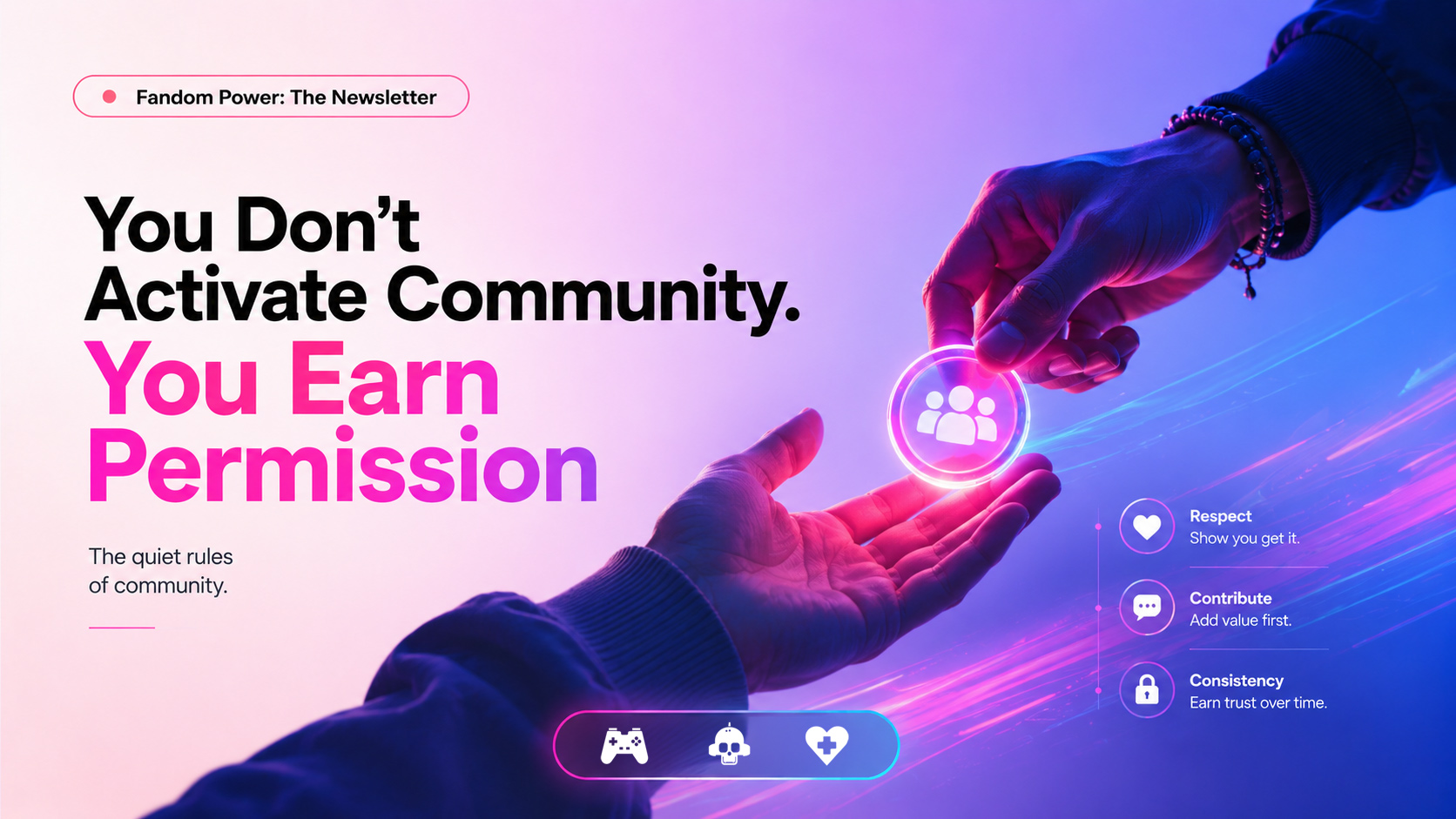
The quiet rules of community
There’s a phrase that is increasingly showing up in project briefs: community activation.
It usually means well. It signals the brand wants closeness, relevance, and participation. But it also reveals a misunderstanding that fandoms spot instantly.
Because communities aren’t things you just ‘activate’. There’s no buttons you simply press. It’s more complex than that.
If you’re trying to “activate” people who haven’t been respected, listened to, or given anything meaningful to hold onto… what you’re really doing is asking for energy you haven’t earned.
And fans are very good at saying no.
The difference brands keep glossing over
I’ve said it many times before… Most brands don’t have communities. They have audiences.
An audience is passive. It consumes what it’s fed. It engages when prompted. It disappears when the content stops.
A fandom is active and organic. It has a life of its own. People talk when you’re not in the room. They create, interpret, argue, defend, remix, and amplify because they care. They do the marketing for you, but only when it feels like it belongs to them as much as it belongs to you.
Calling an audience a community doesn’t make it one. It just sets expectations you can’t fulfil.
Why “activation” often backfires
When brands treat community as something that can just turn on, the community reads it as an intrusion (and usually an unwelcome one at that).
The tell is always the same… the brand shows up loudly when it wants something (attention, sales, sign-ups), and disappears when the community needs something (clarity, protection, accountability, continuity).
That pattern trains people not to invest emotionally.
Fans aren’t anti-brand. They’re anti-transactional intimacy. They know the difference between being seen and being used.
Appreciation is where everything starts
The brands that earn real community aren’t the ones with the slickest activation or the most comments per post.
They’re the ones who demonstrate genuine appreciation for the people who keep the world alive.
Appreciation isn’t a tone-of-voice exercise. It’s behaviour.
It looks like:
- recognising fan labour as valuable, not “free UGC”
- showing up between big moments, not only during launches
- crediting creators and community leaders properly
- protecting spaces from bad-faith behaviour, not over-moderating critique
- being consistent enough that people can trust your intent
That’s what earns permission.
What permission actually means
Permission is when fans allow you to participate in their space without rolling their eyes. It’s when your presence doesn’t feel like an interruption. It’s when your brand becomes legible inside the culture, not just something that awkwardly sits adjacent to it.
Permission shows up in subtle ways:
- fans explaining you to other fans
- people defending your intent during a misstep
- community voices choosing to include you in their stories
- organic amplification that doesn’t need incentives
You don’t get that by asking. You get it by behaving in a way that deserves it.
The quiet rules of community (that brands can’t write, but must respect)
Fandoms have rules, even when they aren’t written down: tone, values, what counts as effort, what counts as a shortcut, what crosses a line. Those rules are enforced socially, and they move fast.
This is why community work feels hard. It requires humility.
You can’t control meaning inside a fandom. You can only earn the right to contribute to it.
A more useful way to think about it
Instead of “How do we activate the community?”, ask:
- Where do people gather when we’re not present?
- What do they do for each other that we could support?
- What are they protecting, and are we respecting that?
- What would make their experience better even if it didn’t benefit us immediately?
Those questions shift your position from extraction to stewardship.
And that’s where real community starts to form.
The takeaway
Start with appreciation. Start with consistency. Start with making it clear you’re there for more than the conversion moment.
Because, while audiences can be prompted and pointed in the right direction, fandoms need to allow permission.
Question for you: where is your most valuable community energy already happening, and what have you done to deserve it?
You can follow more of my writing on Fandoms & Pop Culture:
Linkedin (Free Newsletter): Fandom Power
Substack Premium Newsletter: Fandom Power: Signals
Lets Talk!
If this resonates, I help brands act on exactly this kind of thinking — let’s talk