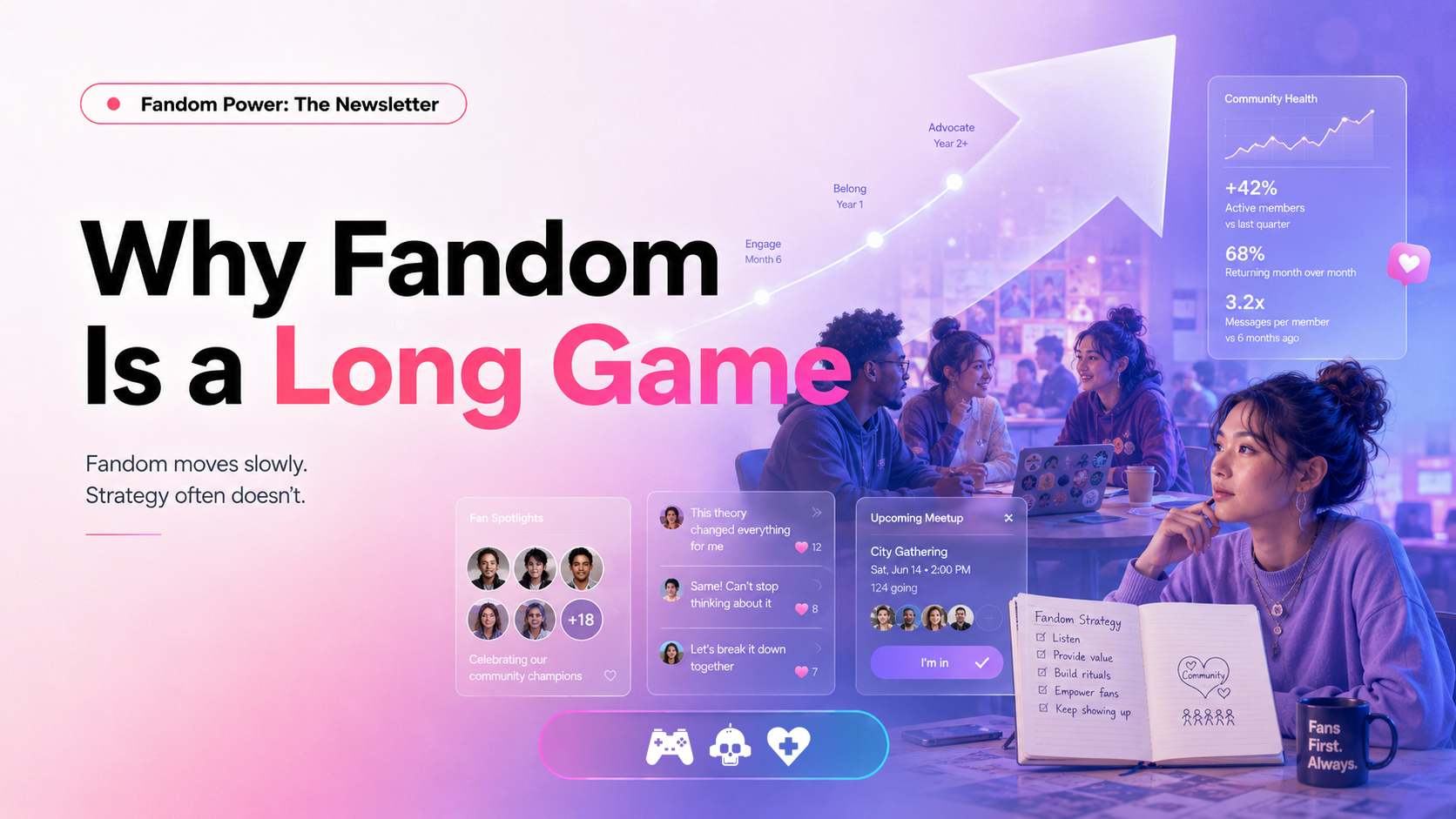
Fandom moves slowly. Strategy often doesn’t.
There’s a mismatch between how fandom works and how most organisations are set up to operate.
A lot of frustration comes from the fact that not enough time ws given…. Brands wondering why momentum fades, communities that never quite form, engagement that spikes and then disappears. It’s not always because the idea was wrong. Often it’s because the timeline was.
Fandom isn’t built in launches, quarters, or campaigns. It’s built over time, and by accumilating trust over a long period.
Fandom doen’t grow through moments
Moments matter. But fandom doesn’t live in single peaks of attention. It lives in what people remember, reference, and carry forward with them.
Fans build relationships with worlds over time, and they notice patterns. They compare decisions, tone, and intent across years, not weeks… quite simply, because fandoms are deeply invested.
That memory is what creates trust. On the flip side, it’s also what erodes it.
You can’t shortcut that process. And when brands try, fandom tends to push back.
Trust compounds slowly, but breaks quickly
One of the hardest truths about fandom is that progress is rarely visible while it’s happening.
When trust is forming, it often looks quiet:
- people return without being prompted
- discussion becomes more nuanced
- critique becomes more specific, not louder
- expectations stabilise
From the outside, it can feel like nothing is happening.
Then something goes wrong, a rushed decision, a tonal shift, a shortcut, and suddenly the response feels outsized. That’s stored memory being activated.
Fandom reactions are rarely about one thing. They’re about everything that came before it.
Why short-term thinking keeps breaking long-term value
Many organisations still approach fandom as something to activate rather than something to earn.
They focus on:
- immediate reach
- fast conversion
- visible engagement
Those things aren’t meaningless, but they don’t tell you whether people are forming an emotional bond or just responding to stimulus.
Fandom doesn’t reward urgency. It rewards consistency.
When output is optimised for speed rather than coherence, fans feel it. When direction shifts without explanation, fans notice. When effort feels disproportionate to extraction, fans disengage.
None of that shows up instantly. It shows up over time.
Patience is strategic
There’s a misconception that playing the long game means doing less.
In reality, it means doing different work.
It means:
- showing up even when attention is low
- maintaining tone and values under pressure
- resisting the urge to chase every spike
- letting meaning accumulate instead of forcing it
This kind of patience is active and intentional. And it’s also really difficult in systems built around constant output and short feedback loops.
It’s also what separates fleeting interest from lasting attachment.
Why fandom survives missteps, but not inconsistency
Fandom is surprisingly forgiving when it believes in the intent.
Fans will tolerate:
- mistakes
- experimentation
- even failure
What they struggle with is inconsistency without acknowledgment.
When decisions feel unconsidered, when lessons aren’t learned, or when the same mistakes repeat, trust erodes. It’s not always a sudden rush, it happens quietly, through disengagement.
The long game isn’t about being flawless. It’s about being honest, and listening to the fans.
The real advantage of thinking long-term
Brands that understand fandom as a long game gain something powerful: resilience.
Their communities don’t collapse after a single bad moment. Their audiences don’t disappear when there’s a lull. Their cultural relevance isn’t dependent on constant reinvention.
They benefit from accumulated goodwill. Something that can’t be bought, rushed, or manufactured, despite how many have tried.
That goodwill is what turns attention into advocacy, and advocacy into longevity.
The takeaway
Fandom doesn’t reward speed. Slow down, aknowledge that it’s a long game, because fandoms DO reward memory, consistency, and care.
If you approach it like a sprint, you’ll get short bursts of noise. If you approach it like a relationship, you build something that lasts.
Fandom is a long game.
And the brands that understand that aren’t always the loudest, but they’re the ones people stick with when it matters.
You can follow more of my writing on Fandoms & Pop Culture:
Linkedin (Free Newsletter): Fandom Power
Substack Premium Newsletter: Fandom Power: Signals
Lets Talk!
If this resonates, I help brands act on exactly this kind of thinking — let’s talk