Most fans don’t start at the beginning… They start with someone explaining why it matters.
That shift is subtle, but it’s one of the most important changes happening in fandom culture right now.
For a long time, entry into fandom followed a fairly linear path. You watched the match. You played the game. You listened to the album. You slowly learned the rules, the history, the context. Knowledge came from participation.
That’s no longer the dominant model.
Today, fans increasingly enter worlds through guides. Breakdowns, explainers, reactions, lore videos, tactical analysis, recap threads, and commentary. They arrive already oriented, already opinionated, already emotionally primed.
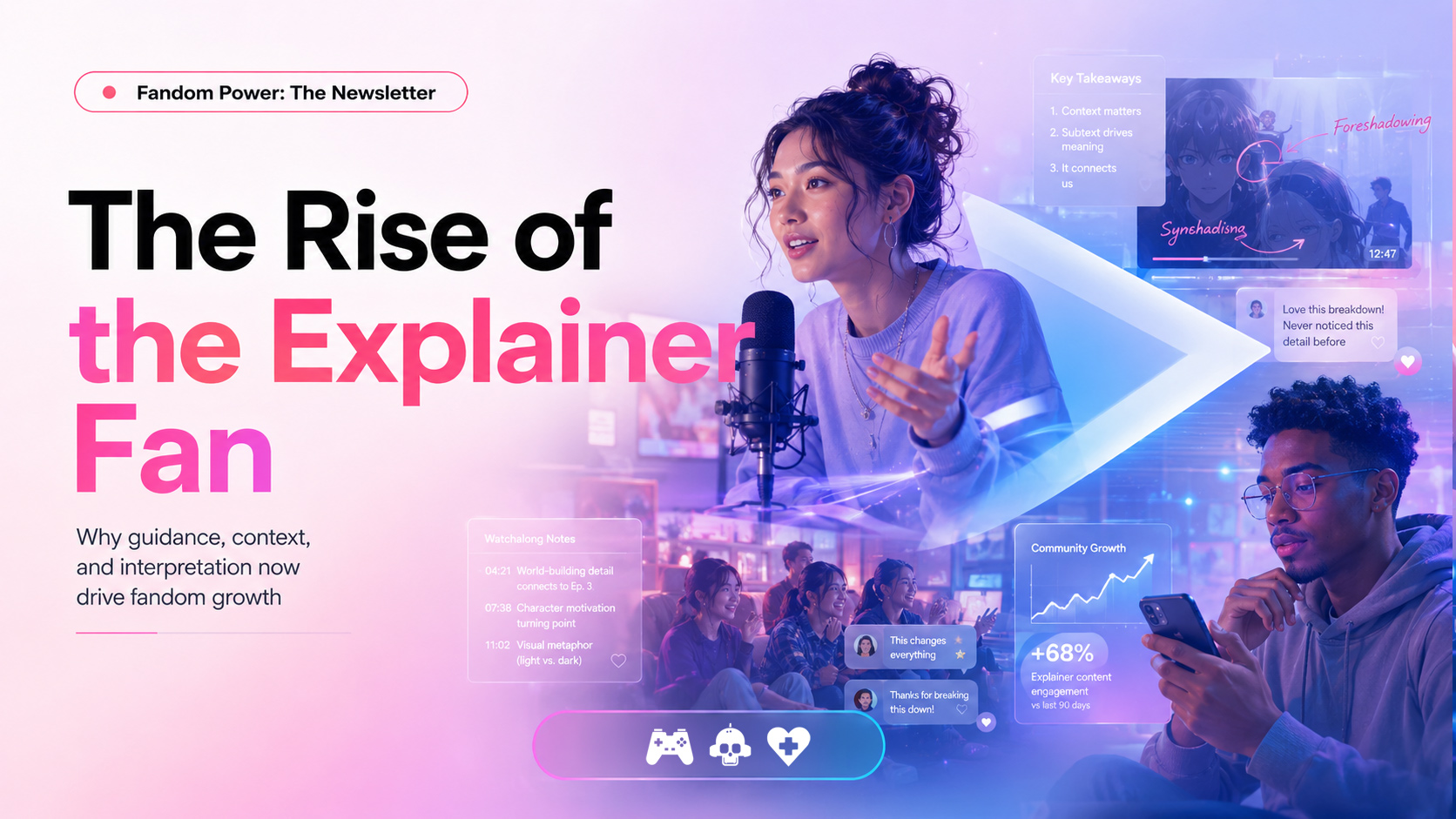
The “explainer fan” isn’t a niche role anymore. It’s becoming the default gateway into fandom.
Why this is happening now
The YouTube Fan Report, alongside what we see across gaming, sport, and entertainment, makes something very clear: fans are no longer content to discover meaning on their own. They want help navigating complexity, and they want it from people they trust.
Worlds have become bigger. Lore is deeper. Schedules are more fragmented. Formats overlap. Keeping up now requires work, and not everyone wants to do that work from scratch.
Explainers reduce friction. They collapse learning curves. They turn “this looks intimidating” into “I get why people care.”
In gaming, that looks like lore channels and build guides becoming as influential as the games themselves. In sport, it’s tactical breakdowns, driver rankings, story arcs, and season explainers outperforming highlight reels. In entertainment, it’s recap culture, theory videos, and “ending explained” content becoming essential rather than supplementary.
The explainer fan thrives wherever the world is too complex to enter cold.
Explainers don’t just inform. They give permission to belong
This is the part that often gets missed.
Explainer content doesn’t just tell people what’s happening. It gives them permission to belong.
When someone explains the stakes, the rivalries, the emotional context, they’re saying: you’re allowed to care now. You don’t need years of history. You don’t need credentials. You don’t need to prove yourself.
That’s incredibly powerful in fandom spaces that were once guarded by gatekeeping.
It’s also why explainer fans are trusted so deeply. They help people understand why something matters, not just that it happened.
Official entry points are no longer the main door
One of the biggest implications of this shift is uncomfortable for brands, rights holders, and platforms.
The official channel is no longer the primary point of entry.
Many fans now encounter a sport, a game, or an IP through:
- a creator’s breakdown
- a fan-made recap
- a tactical explainer
- a personality-led reaction
By the time they reach the official account, the emotional framing has already been set.
This doesn’t mean official content is irrelevant, but it does mean it’s often secondary. The tone, expectations, and trust have already been established elsewhere.
Fandoms increasingly learn worlds socially. They learn from, and trust other fans.
What the explainer fan changes about fandom
The rise of explainer fans reshapes fandom in a few important ways:
- Fandom becomes more accessible Entry barriers drop. New audiences arrive faster and in greater numbers.
- Narrative becomes central Explanation prioritises story, context, and meaning over raw information.
- Authority shifts Trust flows toward those who can interpret, not just those who own the rights.
- Engagement deepens earlier Fans often arrive already emotionally invested, not just curious.
This is why explainer culture expands fandom.
The bigger signal
The rise of the explainer fan tells us something fundamental about modern culture.
People don’t want to be shouted at with announcements. They don’t want to be dropped into complexity without support. They want orientation.
When there is seemingly infinite content and limited attention, the ability to explain why something matters has become more valuable than the ability to simply broadcast that it exists.
Fandom doesn’t grow because people discover things anymore. It grows because someone helps them understand what they’re seeing.
And increasingly, the most powerful fans aren’t the loudest ones, they’re the ones doing the explaining.
You can follow more of my writing on Fandoms & Pop Culture:
Linkedin (Free Newsletter): Fandom Power
Substack Premium Newsletter: Fandom Power: Signals
Lets Talk!
If this resonates, I help brands act on exactly this kind of thinking — let’s talk