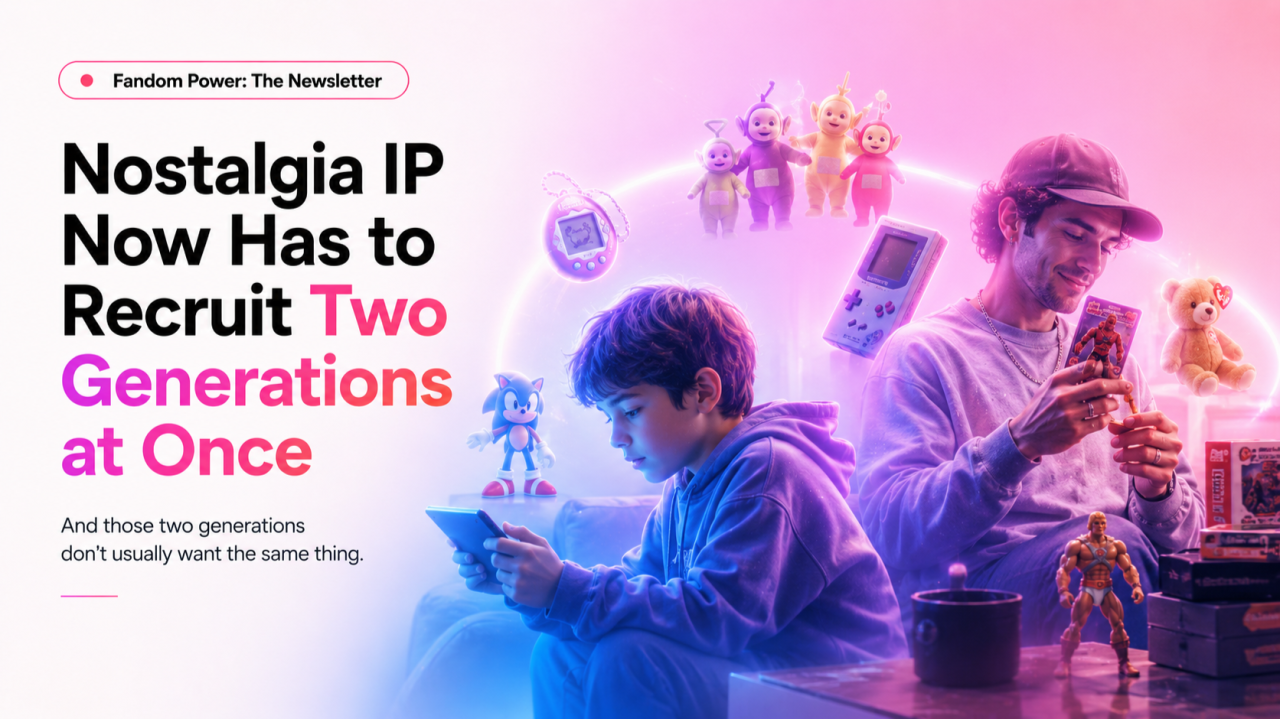
What Toy Story and Supergirl tell us about where fandom actually happens
Toy Story 5 beat Supergirl at the box office, but there’s something interesting happenong behind the numbers.
One franchise turned up carrying thirty years of emotional credit, while the other had to ask audiences to trust a universe that’s still being rebuilt. While the box office numbers show that pretty clearly, they’re only telling part of the story. The way franchises actually live and die in culture now is far bigger, messier and more interesting than the numbers generated on an opening weekend.
On 22 June, AP reported Toy Story 5 opened with $160 million domestically and $152 million internationally… a $312 million global debut. This was the biggest opening of 2026 so far, and the strongest launch in the franchise’s history. A week later it was still No. 1, adding another $70 million domestic and $89.1 million overseas, taking it to $585 million globally after two weeks. Supergirl, on the other hand, opened with $38 million domestically and $30 million internationally, and it landed a 56% Rotten Tomatoes critic score (although let’s be honest, what do critics know).
Those numbers are just a snapshot of one distribution channel on one weekend. The actual ecosystem a franchise lives inside now includes streaming views, YouTube content, gaming tie-ins, merchandise, theme park experiences, social media conversation, fan fiction, creator content, licensed products, soundtrack streams, wiki traffic, cosplay, convention presence and the endless low-level cultural hum of memes, references and in-jokes that keep a property alive long after the initial cinema launch. Box office is still the most visible and talked about metric, but it’s not the whole game… not by a long shot.
Toy Story is one of the clearest examples of what full-ecosystem franchise health actually looks like. Axios reported this month that the franchise has driven around $16 billion in total revenue over thirty years, based on a Disney-commissioned study.
That figure encompasses the full ecosystem… theme park attractions, merchandise, streaming, home entertainment and theatrical, which is what genuine multi-generational IP actually produces when it’s been handled correctly, with consistent care and attention. You can walk into any Disney park anywhere in the world and see just how much Toy Story has a presence. The characters live on children’s bedding and birthday cakes and Halloween costumes, the films stream constantly and the toys have never really left shelves since 1995. Simply put, that’s cultural infrastructure.
The first four films had already pulled in roughly $3 billion at the box office before Toy Story 5 even opened, with both Toy Story 3 and Toy Story 4 crossing $1 billion globally. What the films pull in at the cinema is actually not all that important in the wider story. Toy Story’s real power is that it generates revenue and emotional connection continuously. It’s always on, not just in the weeks around the release of a new film.

I’ve been a Toy Story fan since the start. For the first film, I was there the opening week, with my big brother. I’ve watched every sequel since, with that weird mix of excitement and nerves you get when something you love comes back, and you hope so deeply that it’s good. I honestly think that each film has been genuinely good, but with each step a little of the original magic has been lost. Not enough to break the relationship, but just enough that I notice it.
That’s actually part of what makes this data so interesting to me, because even a franchise that has been losing a small ammount of its magic with each new instalment can still open bigger than ever. The trust that the franchise has built over thirty years is so deep it can handle a slight dip in creativity or heart and keep growing anyway. And don’t get me wrong… the films are still great. I’m just a sucker for the original and the sequil.
So, how can Toy Story do this? It’s because it’s behaved like a franchise built on life stages, rather than one that is build around releases. For a lot of people these films aren’t just a piece of entertainment, they’re attached to specific moments. Being a kid, leaving home, watching a younger sibling discover the characters for the first time, becoming a parent yourself and realising that a film about toys was always really a film about letting go.
The original came out in 1995, the first computer-animated feature ever made, which means the franchise has now moved through multiple complete generations of childhood and into parenthood.
That’s an impressive emotional infrastructure, and one that shows up across every part of the ecosystem. It’s why a Toy Story ride at a Disney park doesn’t need explaining. It’s why the merchandise sells without a campaign behind it. It’s why parents who grew up with the films actively want to introduce them to their own kids. The franchise remains so strong between the release of new films, because the emotional language is already embedded in culture at every level.
An then there’s Supergirl.
Supergirl has recognition, but that recognition is far more complex. I’ll be honest.. I’ve been a fan of the character from the comics for a long time and I was genuinely excited for this film. A few months back I was invited onto set during filming, taken backstage and shown around. The attention to detail was properly impressive! From the intricate props, set design, costume work, hidden easter eggs tucked away into the artwork displayed on walls, and the messages scrawled on walls. I even got to bring home a prop alien snack from set, which is now sitting on a shelf in my office. The actress playing Supergirl, Milly Alcock, is fantastic. The craft was real and the love from the people making it was obvious.
And, s much as it hurts to say, none of that matters if the emotional connection doesn’t land with the audience. Craft, detail and genuine love from the people making something don’t automatically transfer into trust from the people consuming it. You can do everything right at a production level and still lose the bigger emotional argument.
The film landed as the second major chapter in James Gunn and Peter Safran’s rebuilt DC universe, following 2025’s Superman, which grossed $618 million worldwide. But the DC ecosystem challenge is far more difficult than the numbers generated by any single film.
Marvel at its peak wasn’t just drawing in huge box office numbers. It was also winning across gaming, merchandise, theme parks, streaming, creator content and the kind of daily social presence that kept the universe feeling alive. It always elt like it was growing, even between films.. The MCU became a fandom ecosystem, with fans doing homework voluntarily, rewatching films to catch Easter eggs, building theories, playing the games, buying the Funko Pops, arguing on Reddit. The films were the biggest peaks, but they were nesstled in the heart of a media landscape that never stopped or never slowed down.

DC is trying to rebuild that landscape from scratch, which is an enormous ask.
Entertainment Weekly reported Supergirl carried an estimated $170 million budget against a $68 million global opening, with pre-weekend projections that had softened from around $50 million domestic. But the real question is whether the broader DC ecosystem is generating the kind of energy between releases that makes audiences feel invested. Not just when they’re sat in the cinema, but in the time between films.
Superhero films no longer driving the box office the way they did pre-pandemic. In fact they’re down about $3.5 billion annually from the 2017 to 2019 highs. Reuters reported in April that action and adventure accounted for 35% of ticket sales from the top 100 films in 2025, tied for the lowest share since 2010, while family and horror films gained ground.
Seeing that as a decline in interest in superhero films, kind of misses the point. The audiences haven’t gone anywhere. They’re still watching superhero content constantly, through streaming, animation, gaming and creator video. What’s changed is the bar for getting them into a cinema. A lot of that is built on trust rather than just recognition.
I’d push back on the superhero fatigue label entirely. Fatigue makes the audience sound passive or bored, and they’e not. But they are tired of being asked to invest emotionally in franchises and stories that might not pay off. They’re tired of stories that feel like connective tissue between the films they actually wanted.
Toy Story works because the emotional bill has been paid, repeatedly, for thirty years, and across every part of the ecosystem simultaneously.
For anyone building franchise strategy, and it goes well beyond film… the ones that win long-term won’t be the ones with the most IP or the biggest opening weekends. They’ll be the ones that understand what fans are actually protecting.
Fans are always protecting something. They’re protecting the version of themselves that loved the thing first. The memory of whoever introduced it to them. The emotional meaning the franchise has built up across their own life.
At every touch point, and every moment a fan connects with the franchise, you’re handling someone’s memory, and the audience knows immediately whether you’ve treated it with the care it deserves.
Toy Story 5’s performance, across box office, merchandise, theme park attendance and the sheer volume of organic social content from parents watching it with their kids, shows how powerful that memory becomes when it’s handled with genuine care over decades.
Supergirl’s opening shows how vulnerable even genuinely famous IP can be when recognition outruns trust, even when the people making it clearly gave everything they had.
Looking to go deeper?
Check out my Substack Fandom Power: Signals
Fandom Power: Signals is a Substack for people who need to understand how fandom actually works , and what that means for strategy, growth, and commercial decision-making across sport, entertainment, gaming, fashion, music, and culture.
If the free Fandom Power newsletter on LinkedIn explores what’s happening in fandom culture, this is where we focus on what to do with it.

About Calvin Innes
Calvin Innes is a Fandom & Pop Culture Creative Strategist and Consultant. He is the person brands call when they want to understand, and connect with culture. 25+ years experience working with global brands, agencies and organisations. Clients including Sony, HBO, Adidas, Unilever and Pokémon. Available for consulting, pitch support, workshops and keynotes. calvininnes.com