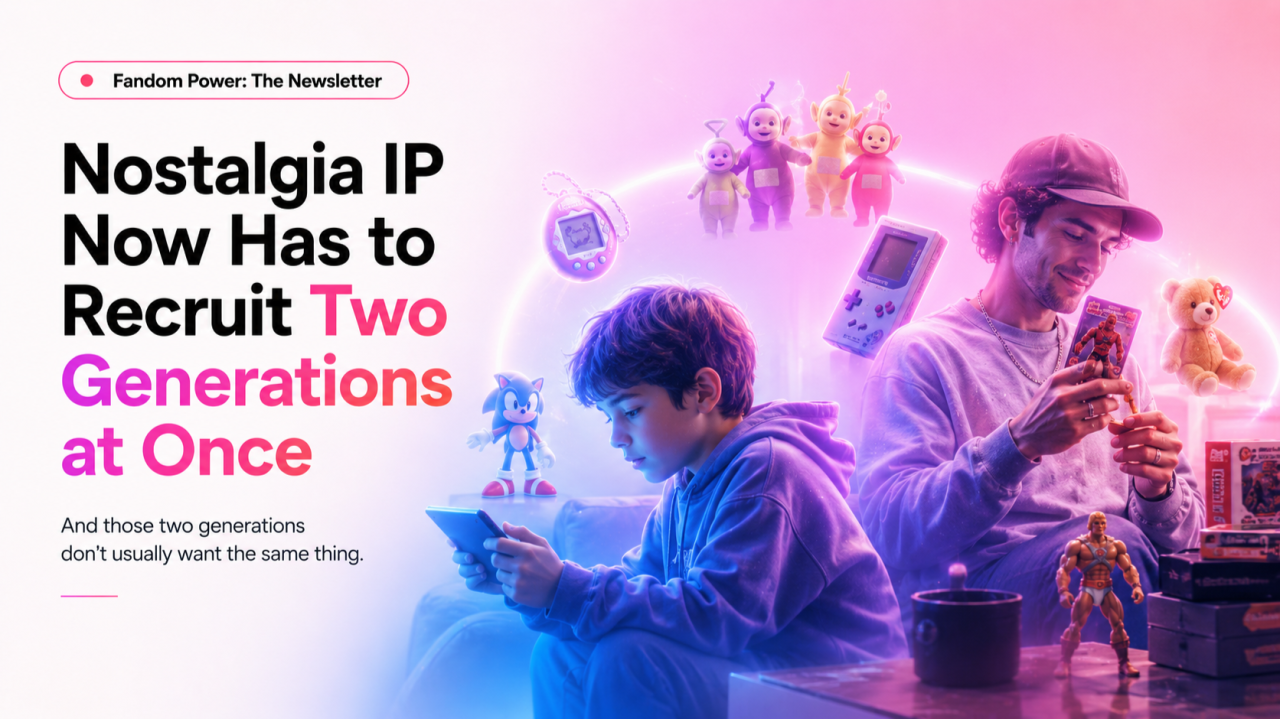
And those two generations don’t usually want the same thing.
The Teletubbies opening a retail store in China sounds like a strange sentence. It’s also a genuinely useful signal about where children’s IP is heading.
WildBrain has opened WildBrain Garden in Zhongshan, its first permanent retail store dedicated to Teletubbies and In the Night Garden. The 930-square-foot store sits inside the new Magic World Family Entertainment Center, selling plush, collectibles, accessories and gifting products. A second location is already planned for Beijing in 2027, timed neatly for Teletubbies approaching its 30th anniversary and In the Night Garden its 20th.
At first glance this is just another piece of licensing news. A preschool brand opens a shop, cute characters get plush versions, families buy things, blah blah blah. But I actually think it’s far more interesting than that, because it points to a challenge every ageing children’s brand now faces: nostalgia IP has to recruit two generations at the same time, and those two generations don’t usually want the same thing.

Children want play, softness, character recognition and, crucially, parental permission. Adults want emotional retrieval, display, social proof, and collectability as well as that small warm hit of “I remember this.” Physical retail is one of the few places those two very different needs can actually be addressed in the same moment. The Teletubbies store doesn’t rely on everyone sharing the same media relationship with the property. A child walks in because the colours and characters are immediate and legible. A parent walks in because the brand still carries that weird, soft-focus memory of late-90s children’s television. The store becomes a translation layer between first-time affection with an IP and adult nostalgia around that same IP, and that’s a seriously hard thing to engineer through content alone.
This is happening right across the toy and IP world. Circana reported that across 12 global markets, including the UK, US, France, Germany, Spain, Italy, Canada and Australia, toy sales grew 7% in value in 2025 after three years of decline. The Toy Association’s summary of that data credits the rebound to pop culture, licensed products, collectibles and teens and adults returning to toys as a form of affordable entertainment, coupled with cultural touchpoints.
In the UK, the kidult market has become a serious commercial force over the past few years. Circana put the 12+ toy market at £1.2 billion, accounting for 31% of total toy spend, which is roughly one pound in every three spent on toys in Britain. Even more revealing, 43% of adults aged 18 and over bought a toy for themselves or another adult in 2025, rising to 76% among Gen Z shoppers aged 18 to 34.
The data fundamentally changes how we should think about children’s IP, because the buyer isn’t always buying for a child. Sometimes the adult is buying for themselves. Sometimes they’re buying for a child and themselves in the same transaction. Sometimes the child is the excuse, and the adult memory is the real demand driver.
Tamagotchi is a great example of how to work this two-generation engine well. The original digital pet launched in 1996 and has now crossed 100 million units shipped worldwide, according to Bandai’s 2025 milestone reported by Toy People, with more than half of those shipments outside Japan.

Bandai brought back Tamagotchi Connection in 2024 for the product’s 20th anniversary, keeping the nostalgic shape but updating the colours and adding a ball chain so people could clip it to their bags. By 2026 and the 30th anniversary, Tamagotchi had moved into lifestyle collaborations, including CASETiFY’s first-ever custom-branded Tamagotchi device alongside phone cases, charms and travel accessories.
Tamagotchi isn’t only being sold as a toy anymore. It’s being worn as a signal!
Teen Vogue’s March 2026 analysis framed the return as part nostalgia, part Y2K fashion, part bag-charm culture and part quiet rejection of invisible, frictionless digital life. The device works precisely because it’s both playable and visible at the same time. You care for it, but you also carry it. You remember it, but you also style it. Tamagotchi has managed the thing most nostalgia brands fail at: it gives adults their childhood back without trapping the brand in the past. The object itself still feels childlike, but the behaviour around it now belongs to adults too, through customisation, collecting, accessorising, posting, matching colours to outfits and treating a digital pet as part of personal identity.
The old emotional code survives while the current behaviour evolves, and that’s nostalgia IP operating at its strongest.
Jellycat is another eample of that same shift. Founded in London in 1999, Jellycat’s recent growth has come not from the plush itself but from turning plush into experience, performance and adult-friendly emotional retail. The Jellycat Fish & Chips experience at Selfridges isn’t a shelf of soft toys. It’s an interactive counter-service ritual where customers “order” plush versions of fish, chips, peas and other British food characters. Jellycat designed it explicitly for families, collectors and fans, and products bought through the experience come with special packaging, stickers and pin badges you can’t get anywhere else.

That’s very clever retail thinking, because it stacks so many jobs into one interaction. The product is cute, so it works for children, and the ritual makes it memorable. The exclusive packaging makes it collectible, and the theatrical perfomance at the counter makes it postable and shareable. The British chip-shop reference makes it locally fluent. And the sheer absurdity of solemnly ordering a plush portion of chips makes it irresistible to adults.
Jellycat isn’t a nostalgia IP in the way Teletubbies or Tamagotchi are, but it proves the same underlying point, that the most powerful toy retail now behaves less like a shop and more like a fan ritual. People aren’t only buying the plush, they’re buying the story of buying it.
TIME named Jellycat one of its most influential companies of 2026, reporting it works with more than 7,000 retailers in 80 countries, with sales rising from $252 million in 2023 to $446 million in 2024. CEO Arnaud Meysselle told TIME that fans wanted “real, joyful, memory-making moments,” which is a really good description of what these experiences are built for.
Pokémon is the genuine masterclass in doing this across multiple generations. The Natural History Museum in London opened Pokémon’s first UK museum pop-up shop for the franchise’s 30th anniversary, transforming its Earth Hall Shop into a Pokémon experience with exclusive collaboration products. Demand was strong enough that the run got extended by four weeks, tickets were initially required, some original stock sold out entirely, and the free oversized “Pikachu at the Museum” trading card had gone by the time the extension ran. The collaboration works because it recruits different audiences through different meanings simultaneously. For children, Pokémon is creatures, play, cards and recognition. For many adults, it’s Game Boy memory, schoolyard trading, 90s and 00s nostalgia, collecting and the quiet comfort of a world that has kept expanding for three decades without ever losing its central language. And for the museum, Pokémon maps beautifully onto exploration, taxonomy, nature and discovery, which is what made the pairing feel earned rather than opportunistic.

The venue itself does something powerful here too. Pokémon in a museum feels fundamentally different from Pokémon in a toy aisle. It grants the IP cultural permission and turns merchandise into a day out. More importantly, it removes the faint awkwardness of adult play. A grown adult buying plush online might feel a little indulgent about it. That same adult visiting a themed pop-up or a museum collaboration is participating in culture, and the venue offers even more legitimacy. That’s one of the most underrated things physical retail does for nostalgia IP.
Sanrio and Hello Kitty demonstrate the sheer scale this reaches when a character has real multi-generational elasticity. Hello Kitty turned 50 in 2024, but rather than treating that as a heritage victory lap, Sanrio turned it into commercial acceleration. In FY3/2025, sales rose 44.9% year on year to 144.9 billion yen, while operating profit jumped 92.2% to 51.8 billion yen, driven by global brand-building around the anniversary, with notable growth across North America, Europe and Mainland China. What makes Sanrio genuinely clever is that it doesn’t lean on one character to carry all the emotional weight. Its annual Character Ranking has become a fandom ritual in its own right. In 2026, People reported the contest received more than 70 million votes, the most in its history, with Pompompurin taking top spot for the second year running.
That points to something nostalgia brands consistently underestimate: they need mechanisms that keep the fandom active and relevant. Hello Kitty’s 50th created a memory hook for adults, but the wider character ecosystem gives fans ongoing reasons to choose, vote, compare, collect and identify with the IP. That’s how a children’s character company becomes a culture system rather than just another piece of heritage.
Labubu and Pop Mart show the more volatile, collector-driven edge of the same kidult economy. Labubu isn’t an old childhood property like the others, but it sits inside the same adult toy and collectible behaviour, built through physical stores, blind boxes, scarcity and emotional consumption. Reuters reported Pop Mart’s 2025 revenue rose 185% year on year to 37.12 billion yuan, with profit attributable to owners up 308%. The opportunity there is obvious. Adults are willing to buy toys when those toys carry identity, scarcity, community and emotional comfort. But collectibles can overheat, and Reuters also reported investor concern about the durability of top IPs and a material slowdown in Pop Mart’s fourth quarter.

For nostalgia IP specifically that’s super important, because memory alone can’t protect a brand from boom-and-bust mechanics. Scarcity creates heat and collectability drives repeat purchase, but long-term staying power needs more than the thrill of the next drop.
Which is exactly what makes the Teletubbies store more interesting than it first looks. Its success won’t be measured only by whether adults buy another collectible plush because they remember the show. The interesting thing is whether the brand can build a physical world that works for children and adults at once, in a market where location-based entertainment, character retail and family destinations are already highly sophisticated.
WildBrain’s own positioning leans directly into this, describing location-based entertainment as a key growth driver and framing WildBrain Garden as a way of taking brands beyond the screen. For older children’s IP the screen relationship is often uneven. Some adults remember the original show vividly, some parents barely know it, and some children today meet the characters through YouTube, streaming, merchandise or an installation or mascot costume on a day out, rather than through traditional TV. Physical retail makes the encounter far less dependent on media. You don’t need to have watched every episode to understand a collectible toy or plush on a shelf, or a character environment, or a photo moment or a themed gift. The store brings the distance between generations much closer together.
Nostalgia IP is becoming spatial. It’s moving into stores, cafés, museums, pop-ups, themed counters, immersive shops, exhibitions and location-based entertainment, because the physical destination gives people a reason to gather around something.
Nostalgia gets treated as something that only lives in the past, but the strongest nostalgia IP uses the past to trigger a behaviour, right here and right now. Tamagotchi becomes a bag charm in the same way that Jellycat becomes an in-store performance. Pokémon becomes a museum visit, Hello Kitty becomes a voting ritual and a social-commerce engine, and Teletubbies becomes a China-specific retail world. The best nostalgia IPs don’t just ask people to remember… they give people something to do with that memory.
Physical retail is so useful because it can hold both audiences without forcing the brand to choose. A child sees colour, character and play. An adult sees memory, design, collectability and social value. A family sees a day out, whereas a collector sees a limited object, and a retailer sees dwell time, while a licensor sees monetisation that doesn’t depend on content.
This is remarkably efficient when it’s built with care.
Looking to go deeper?
Check out my Substack Fandom Power: Signals
Fandom Power: Signals is a Substack for people who need to understand how fandom actually works , and what that means for strategy, growth, and commercial decision-making across sport, entertainment, gaming, fashion, music, and culture.
If the free Fandom Power newsletter on LinkedIn explores what’s happening in fandom culture, this is where we focus on what to do with it.

About Calvin Innes
Calvin Innes is a Fandom & Pop Culture Creative Strategist and Consultant. He is the person brands call when they want to understand, and connect with culture. 25+ years experience working with global brands, agencies and organisations. Clients including Sony, HBO, Adidas, Unilever and Pokémon. Available for consulting, pitch support, workshops and keynotes. calvininnes.com