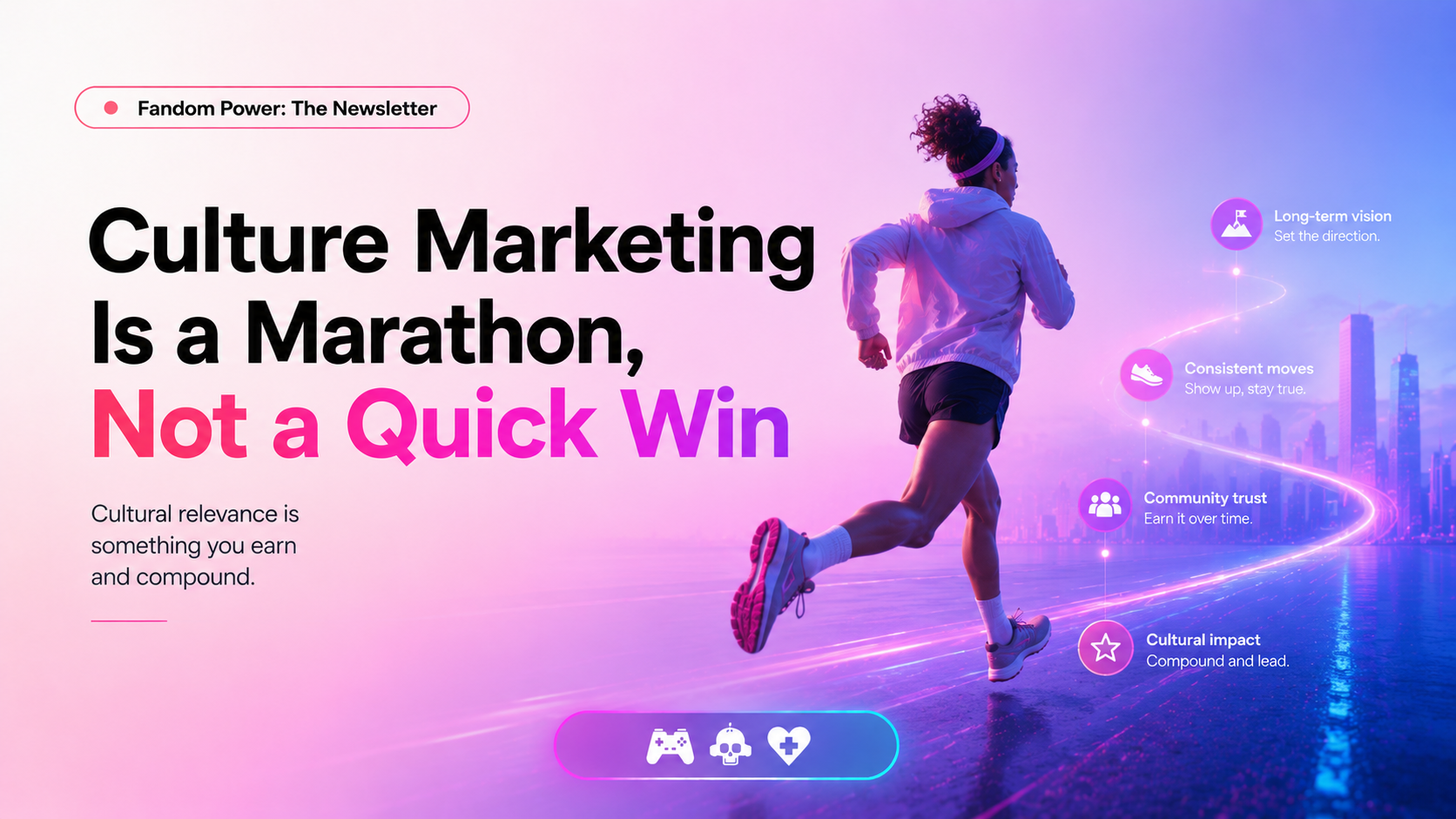
Cultural relevance is something you earn and compound
There is often a rush to create and to entr fandom spaces, and that is counterintuitive to how fandoms work.
Picture it…. The brief is urgent, the timeline is tight and the expectation is that culture can be “won” in a week, with the right partnership, the right meme, or the right stunt.
Sometimes that works. You get a spike in attention. A PR story you can screenshot for your creds deck. Maybe even a round of applause from the client.
Then the moment passes, and you’re back where you started.
That’s the trap: treating cultural relevance like a one-time prize, rather than something you earn and compound.
Culture is built over time, on memories and recognisable moments
It doesn’t reward the loudest message… It rewards the clearest pattern.
People decide what to trust based on repetition: the same tone showing up again and again, the same values holding under pressure, the same signals returning across different moments. This is why fandoms are so powerful as a lens. Fandom isn’t built on a single drop. It’s built on continuity, ritual, and shared language that accumulates over time.
Brands that last culturally aren’t “hacking” attention. They’re building a place in a fandoms memory.
The evidence already points to this
Marketing effectiveness research has been saying this for years: long-term brand building and short-term activation work best in balance, not in isolation. The IPA’s work on The Long and the Short of It is famous for suggesting an “optimum” split around 60/40 between brand building and activation, and later analysis kept that “sweet spot” broadly consistent (e.g., 62/38 in subsequent reports).
Simply put, this is a description of how humans work: we need repeated emotional signals before we change our behaviour.
Even more recently, the IPA published analysis (Jan 2026) finding that advertising which significantly increases brand trust is highly effective at driving business growth. Trust compounds. You can’t brute-force it.
And Kantar’s BrandZ work has repeatedly linked long-term growth to brands that build both meaning and difference over time (including reporting large average gains in brand value for brands perceived as both “Meaningful” and “Different”).
The conclusion is unglamorous, but useful: the strongest commercial outcomes tend to come from sustained, coherent investment, not bursts of cultural cosplay.
Why fandom makes this obvious
Fandom is a long game by design.
Fans don’t amplify because they were targeted well. They amplify because they feel seen, and because they’ve built a relationship with a world over time. They remember how you treated the community last year. They remember whether you showed up between releases. They remember whether you kept the tone consistent, whether you listened, whether you took shortcuts.
That’s why the brands that win in fandom-led categories aren’t necessarily the funniest or the fastest. They’re the ones that build a repeatable sense of “this is who we are,” and let the community do what communities do: interpret, remix, defend, recruit.
A campaign can buy attention. Only time can earn attachment.

What compounding looks like in practice
Compounding isn’t just about posting more. It’s choosing a cultural position and reinforcing it until it becomes recognisable.
It looks like:
- returning to the same few values (even when the internet moves on)
- building rituals that people anticipate (not just announcements)
- keeping your creative language coherent across channels and moments
- letting community participation shape the story, not just react to it
This is why the brands that feel culturally embedded are rarely doing “random acts of relevance.” They’re making consistent deposits into the same emotional bank.
You can’t shortcut belief
A lot of marketing is still built on a conversion fantasy… if you get the right reach, people will care.
Caring is slower than that.
People care when something fits their identity, when it respects their intelligence, when it feels like it will still be here tomorrow, and when it has enough continuity for them to build shared meaning around it.
That’s why the marathon frame matters. It changes what you prioritise:
- consistency over cleverness
- trust over tactics
- memory over moments
- community respect over “activation” language

A client-grade way to say it
If I were advising a brand trying to “do culture,” I’d say this:
Stop chasing spikes as proof of relevance. Pick a cultural thesis you can live with for 12–18 months. Invest in trust-building creative that people recognise, not just notice. Use short-term activations to convert demand, but don’t confuse them for the strategy. Measure whether you’re building memory: return behaviour, organic advocacy, creator adoption, community language.
Because cultural marketing that doesn’t compound ends up as an expensive hobby.
Culture pays interest when you stay consistent long enough for people to believe you mean it.
Ask yourself, what would change in your marketing if you planned for compounding first, and “campaign moments” second?
You can follow more of my writing on Fandoms & Pop Culture:
Linkedin (Free Newsletter): Fandom Power
Substack Premium Newsletter: Fandom Power: Signals
Lets Talk!
If this resonates, I help brands act on exactly this kind of thinking — let’s talk