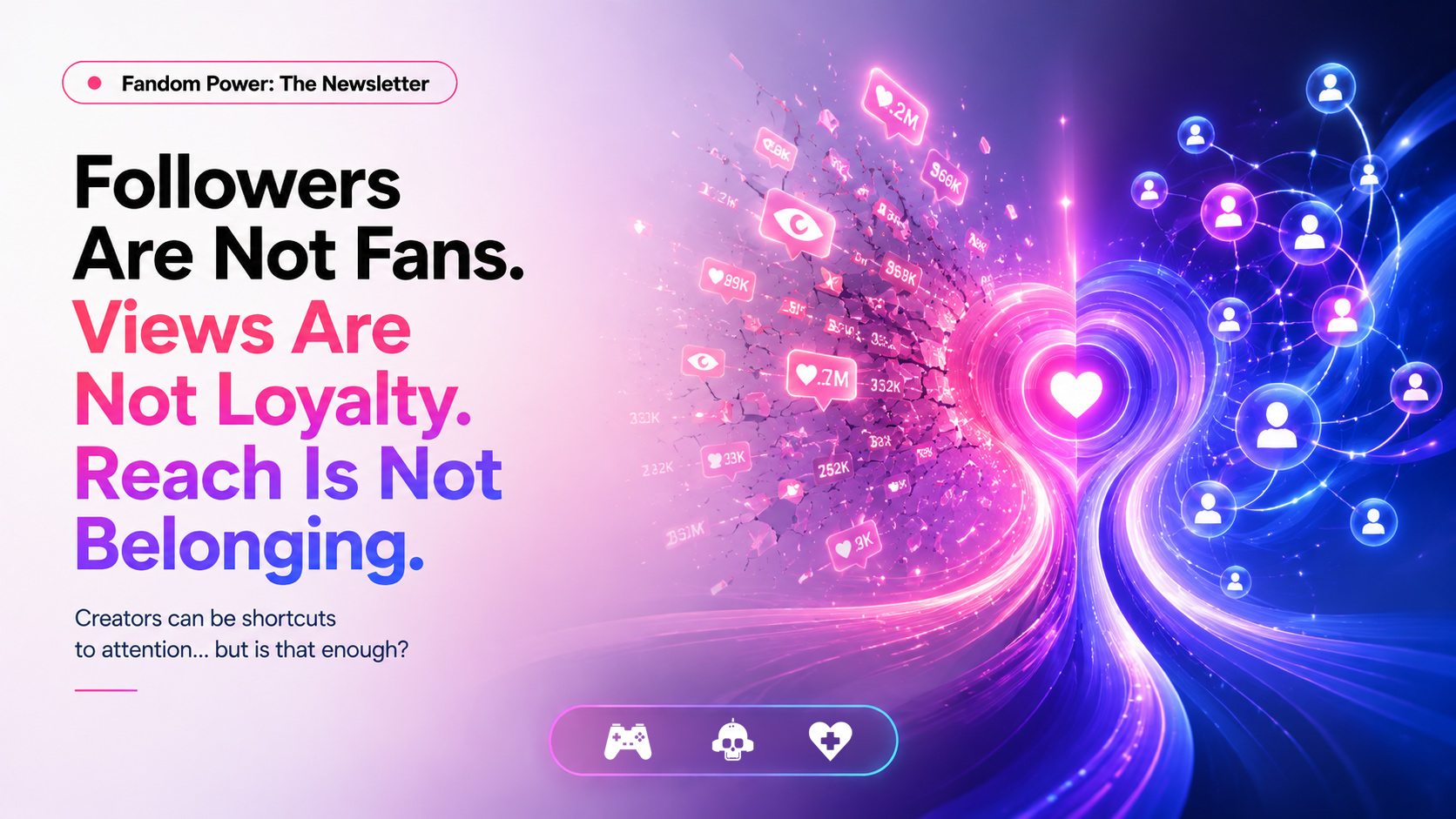
Creators can be shortcuts to attention… but is that enough?
For years, brands, platforms and entertainment properties have treated creators as quick access to attention. The format is pretty simple.. Find the right face, borrow their audience, and convert that moment of attention into mass visibility.
And to be fair, that logic still works, up to a point.
A creator can absolutely make something famous for a day. They can still turn a product into a talking point, or raise a song into a trending sound, they can turn a show into a meme, or a brand into a conversation. But it’s usually over as quickly as it began.
Because reach is not fandom.
Theh gap between the people who can bring an audience to the door and the people who can make that audience come back is already pretty clear. With with an ever increasing amount of fast, and cheap content and Ai influencers, that gap is becoming more and more obvious.
Digiday recently published a piece on Baller League, which is really interesting. The headline is prety self explanitory “reach is not the same as fandom.” The six-a-side football league is creator-managed, streamed free on YouTube and Twitch, and deeply embedded in entertainment culture. But its ambition has never been to just become another company churning out content. Its stated ambition is to become a sustainable sports league.
According to Digiday, Baller League is trying to build the sport first, not just the spectacle around it. Its organisers say matchday livestreams average more than four million views, while the league also tracks viewer drop-off minute by minute and measures what it calls fan conversion: the share of a creator’s audience that actually becomes a Baller League fan.
That last part is the really interesting bit. It’s not about the creators or the livestreams, or not even the really impressive numbers around viewers an engagement.
The really interesting thing here is the focussed shift from audience acquisition to fan conversion.

To creator or not to creator?
When identifying a creator to work with, the question is usually prety simple. How many followers do they have any how many people can they reach?
In fact, the question that is far better to ask is, what does their audience already know how to do?
Do they watch together? Do they debate? Do they buy? Do they attend? Do they remix? Do they defend? Do they recruit other people to the fandom? Do those people follow the creator into new worlds and interests, or do they only show up for the creator themselves?
This is where a lot of creator-led IP can, and does struggle. A creator’s audience is not automatically transferable to everything they endorse or speak about. The audience may be deeply loyal to the person, but indifferent to the property they are tryng to promote. It may love the content, but not the underlying sport or product or brand. If that’s the case, they may watch once out of curiosity, then simply disappear.
That, in a nutshell, is the difference between borrowed attention and earned behaviour.
Baller League’s own numbers, as reported by Digiday, make this point very clearly. Some creators convert a meaningful share of followers into league fans, while others bring broader visibility but much lower conversion. The same article says KSI and iShowSpeed convert roughly one in every three or four followers, while Odell Beckham Jr. sits closer to one in a thousand, according to Baller League co-founder Felix Starck.
That doesn’t nessisarily make one more valuable than the other. It just means that they’re doing different jobs. One builds audience behaviour, while the other builds cultural legitimacy.
That seperstion is a good way to think of creators. Look at the job they are doping, as part of the entire ecosystem of creators.. not just how many people they can reach.

Fandom is about the relationships people form
Most brands still think that creator value can be judged entirely on the size of their reach, engagement and the pretty vague notion that they can create “authenticity.”
In reality, fandom isn’t just whether people saw the brand/event/sport/product. It is whether they actually formed a relationship with it.
A really important thing to remember is that the most valuable creators are not always the biggest creators. They are the ones whose communities truly engage and who actually care.
A football creator whose audience already watches matches, argues tactics and follows player narratives will convert differently from a celebrity whose audience likes the celebrity but has no strong connection to the sport. A beauty creator whose audience trusts detailed product breakdowns will convert differently from a lifestyle personality who only delivers surface-level aspirational content. A gaming creator whose audience already organises around shared play will convert differently from an entertainer whose following is built around passive viewing.
Another way of looking at it is, reach tells you how many people might arrive. Ritual tells you whether they know what to do when they get there.
Deloitte’s 2026 Digital Media Trends report makes the same point from the consumer side. Around 80% of US consumers in its survey identified as fans of at least one entertainment category, and fans were found to spend more time and money with media than non-fans. More than half of fans said being a fan of a show, artist or franchise often leads them to engage across multiple platforms, and that rises to roughly 70% among Gen Z and millennial fans. The research was based on a US online survey of 3,575 consumers conducted in October and November 2025.
And this is exactly the behaviour I keep writing, and speaking about. Fans (or people for that matter) are not only into one thing. They don’t only operate in one space. It’s more complex than that.
Fans don’t stay in one lane. They move between formats, platforms, purchases, events, comments, clips, group chats and live moments. This can look really messy if you measure them like traditional media impressions. However, if you measure repeat behaviour, it can be extremely valuable.
The creator economy has always been very good at opening doors and getting in front of a lot of people. It has been less good at building rooms where people want to stay.
This is also why younger audiences are so important to this conversation. Deloitte’s March 2026 reporting found that 55% of Gen Z respondents say social media content is more relevant to them than traditional content, while 52% say they feel a stronger personal connection to social media creators than to actors and personalities they see on TV.
That doesn’t mean Gen Z just rejects traditional entertainment, at all. It means the social layer often feels far more intimate or useful, and it’s usually much more culturally alive.
A really good creator can make a sport feel less distant and more accessible. A creator can make an artist feel more understandable and a Twitch streamer can make a game update feel like more of a communal ritual. Just like how a podcast host can keep a particular franchise warm in the down-time between official releases or events.
But again, the point here is not about the creator’s reach. The point is the behaviour they can sustain.

It’s news Jim, but not as we know it
Creators are already viewed asd trusted interpreters far beyond entertainment. A Media Insight Project study published in April 2026 found that 57% of US teens aged 13–17 get news from social media at least daily, compared with 36% of adults. It also found that 81% of teens get at least some news and information from influencers or independent creators. The study was conducted with nationally representative samples of 1,092 adults and 1,009 teens in the US.
For anyone not already aware of the influence (and not just reach) of content creators, this should be something that makes then sit up and pay attention.
Creators are so much more than just sources of traffic. For many younger audiences, they are provide context, and they explain what matters, what is cringe, and what is really worth caring about. They also explain what is suspicious, what is overhyped and what does or doesn’t deserve loyalty.
Obviously, that’s pretty powerful, but it’s also really fragile. A creator can introduce people to a new world and they can lower the barrier to entry.. but they can’t carry the whole thing forever. At some point, the ‘thing’ has to become interesting on it’s own merit, without just borring a famous face.
A lot of creator-first launches make the same mistake. Brands assume that because the creator has fans, the thing they are promoting will inherit their fandom.
It usually doesn’t work like that at all.
Fandom is not inherited. It is transferred, through behaviour.
People have to know what they are joining. They need characters, stakes, language, rhythm, conflict, memory and they need ways that they can participate. They also need a reason to choose a side, and they need enough structure to understand the world, balanced with just enough openness and freedom to make it their own.
That is why Baller League’s franchise ambition is such a useful case to look at. According to Digiday, the league currently owns all 12 teams in each market and plans to sell franchises only once fans have moved from following the league to choosing a team. They recognise that a viewer watches the league, but a fan chooses a side.
If you build it, they will keep coming back…
Brands and agencies can learn something from sport, music and gaming. Put very simply, the best fandoms are not built around reacing as mnay people as possible. They are built around the people who keep returning, again and again.
The creator economy has been over-optimised for the first click, wheras fandom is built on the 5th or 6th, or 56th return.
That leads us to an interesting commercial question.
- Instead of asking which creator has the largest audience, we should be asking which creator can create the strongest pathway into repeat behaviour.
- Instead of asking how many impressions an influencer partnership generated, we should be asking how many people came back organically, when the creator was no longer actively pushing it.
- Instead of asking whether the creator was on brand, ask whether their community had cultural permission to carry the idea and continue to amplify it in a way that feels genuine.
The creator economy is full of people who can make a hell of a lot of noise. The fandom economy, however, will reward the people who can build repeat behaviour and genuine connection.
That is way harder to do. It requires patience, world-building, and it required deper understanding of the crators themselves. Which creators are there to drive numbers, which are there to build credibility, and which are there to translate culture.
It also requires accepting something that goes against the traditional way of thinking… not every big audience is a useful audience.
Some creators are brilliant at generating attention, but they’re really weak at developing a deeper, more meaningful conversion. Some are very niche, but becaue of this niche they have built extraordinary level trust. Some can make people watch, but not nessisarily act. Some can make people act but only in very specific areas. Some bring hype, while some bring depth. And some bring legitimacy… while some bring chaos.
It’s a big mistake to treat them as if they are all just different sizes and shapes of the same thing….. They’re not.
Influencer marketing asks: who can reach them?
Fandom strategy asks: who can make them come back?
You can follow more of my writing on Fandoms & Pop Culture:
Linkedin (Free Newsletter): Fandom Power
Substack Premium Newsletter: Fandom Power: Signals
Lets Talk!
If this resonates, I help brands act on exactly this kind of thinking — let’s talk