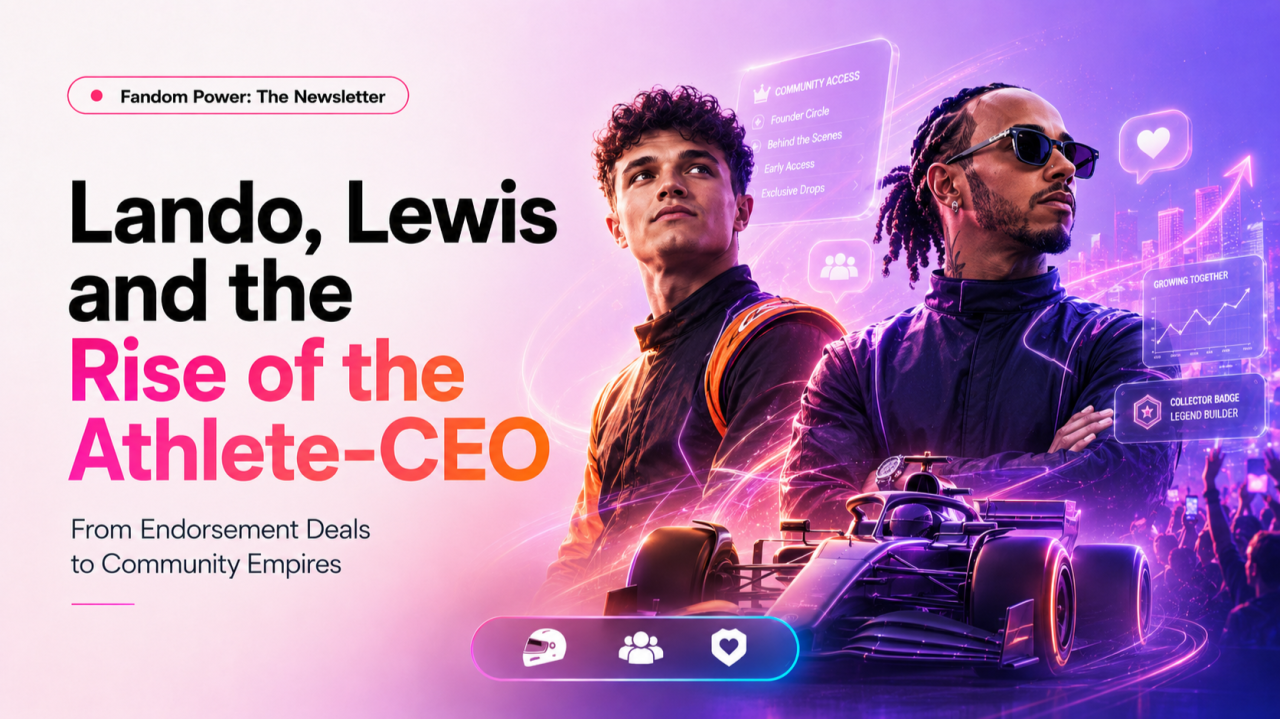
From Endorsement Deals to Community Empires
Silverstone this year showed once again, that modern sports fandom isn’t just built around teams, championships and results. It is increasingly built around people who know how to turn attention into a genuine community.
The 2026 British Grand Prix drew a record 564,000 fans across four days, making it the biggest Formula 1 event ever held. Silverstone also reported more than 16,000 seatsin the sold-out Landostand, the dedicated Lando Norris fan area, with the grandstand essentially becoming a fan club with seats and live action.
The F1 audience itself is changing tin a big way, and has been for some time. The Guardian reported before the race that women made up 43% of British GP ticket sales, while F1’s own 2025 Global Fan Survey found that women accounted for three in four new fans, with nearly half of Gen Z respondents being women. Formula 1 also reported that its global fanbase reached 827 million in 2025, up 12% year on year, with 43% of fans under 35.
Norris, who two weeks ago I spotted in Cannes, is obviously a driver first, but the interesting thing is what sits around him. Quadrant, the gaming, content, lifestyle and apparel business he founded in 2020, describes itself as the “home of new-generation motorsport fandom.” It sits across racing, gaming, creator culture, clothing and digital-native entertainment, which is exactly where younger sports audiences increasingly live. In 2025, Veloce Media Group acquired a majority stake in Quadrant, calling it a content and apparel brand with a clear role in the wider motorsport creator economy.
Norris’s relationship with fans was accelerated during lockdown, when Twitch and sim racing made F1 drivers feel much more human, accessible and socially fluent. Digital Sport reported in November 2020 that Norris had reached around 680,000 Twitch followers, with 76% acquired in 2020, and that he dominated driver video views during that e-racing period.

That was a fairly significant turning point. Before that moment, there were plenty of athletes who had social platforms. But it was around that moment, when some athletes became genuione content creators. They weren’t just publishing highlights or sponsored posts and content dictated by their team. This was much more human, and more natural. They were hanging out, streaming, laughing together, playing games, and giving fans a way to feel close to them without needing to actually be at a race.
The old sports-marketing model treated the athlete as a face or a representive of the team/brand. They would put them in the campaign or put their face on a product. They would feature in advertisements next to the car, or drink, or watch or whatever else. The new model is different, and more complex. The athlete is expected to operate a whole relationship, from content, community, merchandise, events, causes, investments, media, style, gaming and direct fan interactions.
That’s why refering to the athlete as influencer already feels like it undervalues the scale of effort. Perhaps a better framing is, the athlete as a community CEO.
Lewis Hamilton has a mature version of this that has been built over time. Hamilton’s fandom isn’t built only around race wins, although the record at Silverstone still matters enormously. It is built around a wider world of values, style, representation, activism and cultural fluency. His +44 lifestyle brand launched a Silverstone 2026 “Together We Rise” collection for his 20th Formula One season, explicitly tying the clothing to the energy of his fans. His House 44 hospitality experience with Soho House celebrated its first anniversary at the British GP this year, bringing together fashion, music, celebrity, sport and premium fan experience around Hamilton’s orbit.
Then there is Mission 44, which gives Hamilton’s world a deeper values layer. The Guardian reported in April that Mission 44 has reached more than 550,000 young people globally and allocated more than £9 million in grants and support, with programmes focused on education, STEM and representation in motorsport.
Forget personal branding. This is so much more than that, and is effectively a complex and very effective community architecture.

Hamilton has built different ways into his fandom. Obviously, some people enter through racing. But others enter through fashion, or activism. Some enter through representation and others through the emotional story of a Black British driver changing the face of an elite, historically closed sport. The real power is in how those different entry points connect, and recognise the different types of fandom.
This shift didn’t start with F1. Michael Jordan changed the commercial logic in the 1980s. The Air Jordan 1 was released in 1985, and first-year sales reportedly reached $130 million, according to The Henry Ford museum’s collection record. NBA.com has also reported that Nike sold $70 million worth of Air Jordans in the first three months and $126 millionin the first year.
Jordan proved that an athlete could become a cultural powerhouse, and a product line. The shoe wasn’t just for elite athletes. It was about aspiration, rebellion, style, status and belonging. And it’s impact on streetwear culture and fashion has been immense.
David Beckham showed that an athlete could become a lifestyle platform long after they stoppede playing the game. His move from Manchester United to Real Madrid, LA Galaxy, fashion, fragrance, media, Inter Miami and global partnerships helped create the modern idea of a footballer as a powerful brand in intself. In 2022, Authentic Brands Group entered a strategic partnership to co-own and manage Beckham’s global brand, with CNBC-reported deal value around $269 million for a majority stake in DB Ventures.
LeBron James took the next step by building a powerful media infrastructure. UNINTERRUPTED, founded with Maverick Carter, is built around athletes telling their own stories. SpringHill, the wider media and entertainment company co-founded by James and Carter, sold a minority stake in 2021 at a reported $725 million valuation, with investors including Nike, Epic Games, RedBird and Fenway Sports Group.

LeBron’s example in partiicular shifted the athlete from being the subject to becoming the publisher. The athlete no longer had to wait for the broadcaster, the journalist or the sponsor to frame their story. They could create the format, own the audience relationship and decide which parts of themselves became commercially and culturally visible.
Cristiano Ronaldo then showed us the sheer scale of direct fan distribution. When he launched his YouTube channel in August 2024, Guinness World Records said he gained 19,729,827 subscribers in 24 hours, the most ever gained by a YouTube channel in a single day. Reuters reported that he had 1.69 million subscribers within hours of launch, on top of enormous followings across Instagram, Facebook and X.
Ronaldo’s channel wasn’t groundbreaking because footballers had never made content before. They had, plenty of times. It was groundbreaking because it made the athlete’s owned audience the driver of the media launch.

Ilona Maher shows another version, and possibly one of the most important for the future of women’s sport. When Maher made her Bristol Bears debut in January 2025, Reuters reported that the match set a Premiership Women’s Rugby attendance record with 9,240 people at Ashton Gate. World Rugby noted her as the sport’s most popular player by social following, and Reuters linked that following directly to the crowd surge.

Modern athlete fandom is increasingly built through that fluid movement between platforms and behaviours. Deloitte’s 2026 Digital Media Trends research found that nearly half of fans seek fandom-related content from creators, while Deloitte Digital’s sports fandom work found that 71% of professional athlete or sports team fans engage in online communities, 57% interact with creators within fandoms, and 50% seek out fan-created media.
That is why athlete fandom has changed.
It is held together by always-on presence. Training clips, recovery routines, Twitch streams, podcasts, fashion drops, community causes, family moments, creator collaborations, paddock outfits, brand worlds, behind-the-scenes footage and emotional access.
For brands, this creates a huge opportunity and a significant risk.
The opportunity is that athletes can carry communities with far more depth than a generic sports sponsorship. They have personal trust, cultural specificity and emotional permission. A driver like Norris can translate F1 into gaming and youth culture. Hamilton can translate motorsport into fashion, representation and purpose. Maher can translate rugby into confidence, humour and body positivity. Ronaldo can turn global fame into owned media gravity. LeBron can turn athlete voice into production infrastructure.
The risk is that an athlete’s community is not simply a targeting segment with a famous person attached. It has a tone, history and emotional contract. Fans know when a brand fits. They know when the athlete cares. They know when the campaign has been pasted onto a relationship it didn’t help build. They can smell a forced partnership a mile off.
That is the real lesson from the Landostand. It works because the behaviour was already there. Fans already had a sense of Lando as approachable, funny, digital-native and theirs in a way that feels different from older driver fandom. The grandstand didn’t create the community from nothing. It gave the community a physical shape.
The strongest athlete partnerships will do the same. They will not just borrow fame.
They will give existing fandom somewhere to go.
Looking to go deeper?
Check out my Substack Fandom Power: Signals
Fandom Power: Signals is a Substack for people who need to understand how fandom actually works , and what that means for strategy, growth, and commercial decision-making across sport, entertainment, gaming, fashion, music, and culture.
If the free Fandom Power newsletter on LinkedIn explores what’s happening in fandom culture, this is where we focus on what to do with it.

About Calvin Innes
Calvin Innes is a Fandom & Pop Culture Creative Strategist and Consultant. He is the person brands call when they want to understand, and connect with culture. 25+ years experience working with global brands, agencies and organisations. Clients including Sony, HBO, Adidas, Unilever and Pokémon. Available for consulting, pitch support, workshops and keynotes. calvininnes.com