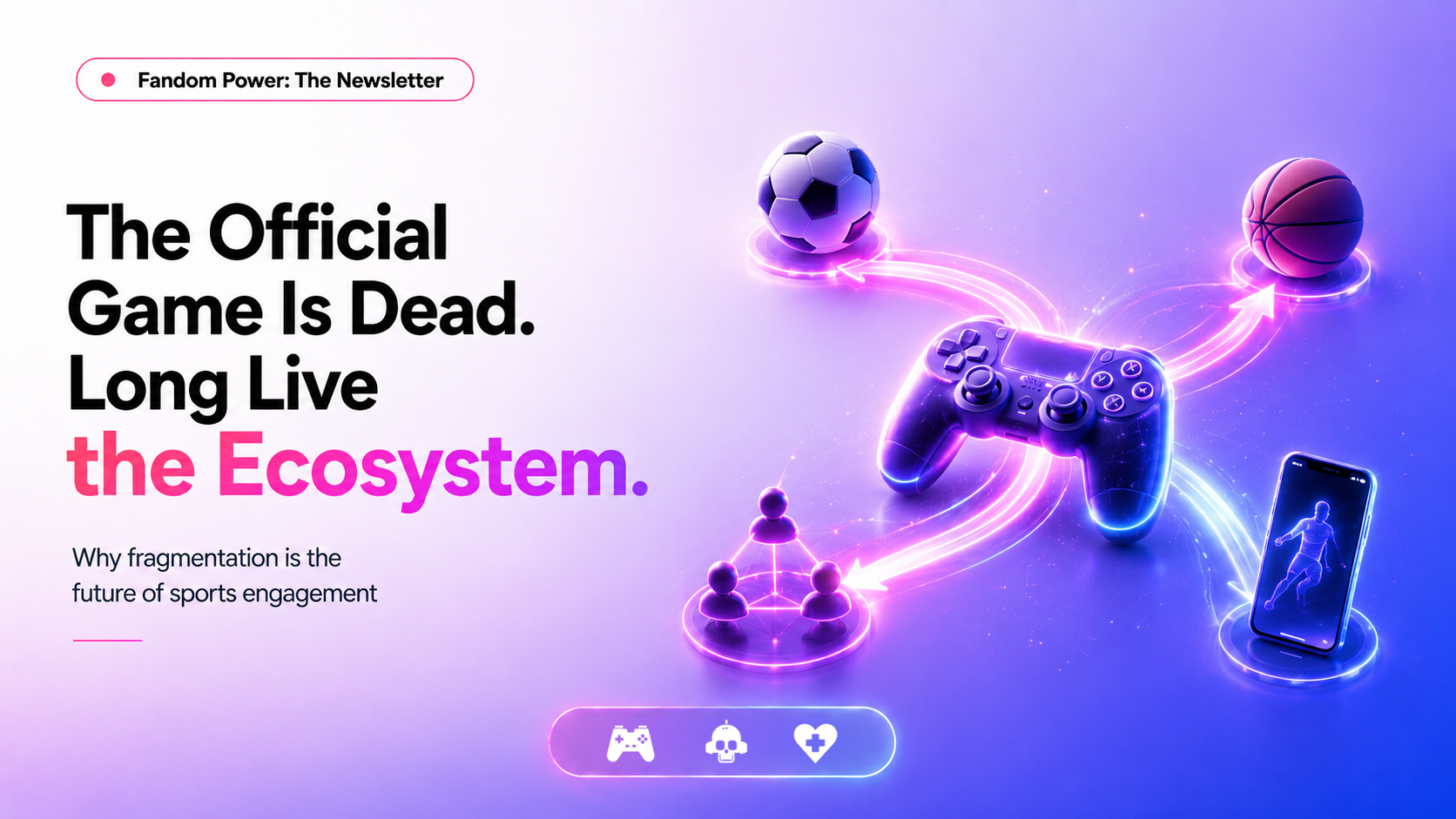
Why fragmentation is the future of sports engagement
For thirty years, football gaming had one cultural front door….You played FIFA.
The game, the ritual, the annual arguments about player ratings, the Christmas tournaments with siblings, the all too familiar controller-smashing losses. It was the emotional centre of football fandom for an entire generation of players, me included.
That centre no longer exists. The landscape has fragmented and there are more options than ever. And honestly? That’s a good thing.
FIFA’s new Netflix Games partnership is the clearest signal yet that sports gaming is moving away from one dominant platform and toward something messier, more fragmented, and ultimately more powerful. On 4 June 2026, Reuters reported that FIFA World Cup: Launch Edition will release on Netflix Games on 11 June, timed with the start of the tournament. Available to Netflix subscribers at no extra cost, it includes all 48 World Cup teams, over 1,200 players, all 16 tournament stadiums, and uses smartphones as controllers for TV play. FIFA described it as part of a broader shift away from the old EA Sports relationship toward a multi-partner ecosystem.
This isn’t FIFA finding a replacement for EA. It’s FIFA refusing to replace one monopoly with another, because they see the wider opportunity.

The portfolio, not the sequel
Cast your mind back to May 2022, when Reuters reported that EA and FIFA were ending their near three-decade partnership. At the time it looked like an ugly divorce. A naming-rights dispute between two institutions that had grown too big for the same room. FIFA wanted to keep esports and gaming rights flexible; EA wanted exclusivity. They split. EA moved forward with EA Sports FC, and FIFA said it would build something new.
Four years later, that decision looks more like a carefully planned strategy (although the chaotic rift can’t be denied).
FIFA’s Digital Football Strategy, published 28 May 2026, explicitly describes moving from a single-partner model into a “structured, multi-partner ecosystem.” Its listed partners include Roblox, Epic Games, Konami, SEGA/Sports Interactive, Gamefam, Mythical Games, Solace Games, Netflix and Delphi Interactive. Different genres, different platforms, different audiences, rather than funnelling every fan into one simulation title.
FIFA Super Soccer on Roblox, developed with Gamefam, is described by FIFA as the largest branded game on Roblox, with more than 10 million monthly active users and over one billion plays. FIFA Rivals, the mobile arcade game from Mythical Games, has passed 2.5 million downloads since launch. FIFAe competitions via Konami’s eFootball have involved more than 120 member associations, more than 16 million players and generated more than 1.1 billion views last year, according to FIFA’s own data. FIFA Heroes, announced in October 2025 with Solace, takes the brand into arcade five-a-side fantasy football with mascots and fictional characters across mobile, Switch, PlayStation and Xbox.
Add the Netflix game and you’ve got six different things a fan can do: play casually, compete seriously, collect, role-play, hang out, represent a nation. Six different fandom jobs.
That’s an entiely new architecture to connect with, and welcome in new fans.

EA still proves the power of the old model
It’d be a mistake to read any of this as the collapse of EA Sports FC. EA is still enormous. Its FY26 results, published 5 May 2026, show record net bookings of $8.026 billion, up 9% year on year, with global football net bookings up mid-single digits across EA Sports FC 26, FC Online and FC Mobile.
More importantly, EA understood the platform logic before most sports rights holders did. When it launched EA Sports FC in 2023, it described FC not as a game but as a platform connecting hundreds of millions of fans across console, mobile, online and esports.
19,000+ licensed players, 700 teams, 30 leagues, 300+ global football partners. EA didn’t just lose the FIFA name and retreat into being a publisher. It built its own football ecosystem.
So what we actually have now is two football fandom platforms, built from different starting points. EA has the deep simulation habit, Ultimate Team culture and the annual sports-game muscle. FIFA has the World Cup, national identity, member associations and the freedom to license different forms of play to different partners. They’re not competing for the same fan in the same moment. They’re competing for share of a fan’s total football life.
That’s a genuinely new dynamic. And it’s playing out across multiple sports.

This isn’t just a football story
The NBA and WNBA extended their partnership with 2K in June 2025, with Reuters reporting a multi-year global deal covering NBA 2K, the G League and USA Basketball. Take-Two’s own FY26 reporting shows why that is so impoprtant commercially. Recurrent consumer spending grew 20% and accounted for 73% of net bookings, with NBA 2K among the largest contributors. That’s sports gaming working as an ongoing identity loop, that just keeps giving. A pretty different model to the old, one off yearly product.
American football shows the same pattern. EA Sports College Football 25 attracted 5 million unique players in its first week after the franchise had been absent for over a decade. The fandom had been building pressure the whole time it was gone. The NFL has used Roblox as a separate youth and global engagement layer, building Super NFL Tycoon to reach markets and age groups that don’t necessarily watch the sport on television yet.
And then there’s Konami, which has built something pretty remarkable. In January 2026, Konami announced that eFootball had passed 950 million cumulative downloads worldwide, supported by a free-to-play model across mobile, console and PC. A billion downloads for a football game most hardcore FIFA fans dismiss.

Why fragmentation can actually deepen fandom
Think about what a young football fan’s relationship with the sport actually looks like now.
They discover a player through a short-form video. They build that player into an EA Sports FC Ultimate Team. They watch their national team during the World Cup. They play a Roblox football world with friends who don’t own a PlayStation. They follow a creator’s pack-opening content. They buy a shirt. Then the Netflix game comes out and they play the tournament mode in the living room with family members who’ve never touched a controller in their lives.
That journey is really messy. Multiple touch points, multiple experiences. However, it’s also far more durable than one annual purchase.
Deloitte’s 2026 Digital Media Trends research supports this. Around 80% of consumers identify as fans of at least one category, and 55% say being a fan leads them to engage across multiple platforms. Among Gen Z and millennial fans, that rises to roughly 70%. Fans spend more time and money on entertainment than non-fans and, crucially, they sustain that engagement over time.
Fandom doesn’t deepen when every experience is the same. It deepens because every experience gives the fan another way to come back.
The console game gives the opportunity for real mastery. The mobile game gives the opportunity for a quick win, daily habit. The Roblox world gives access to social play. The esports circuit gives fans smething to aspire to. The Netflix game gives tournament-season participation with people who’d never otherwise engage. The creator layer provides the commentary and social proof that holds it all together.
That’s the architecture. It’s complex, and it’s multi-facited, but it’s not fragmentation. It’s retention.

The danger
There’s a real risk in all of this, that it’s important to address.
Fragmentation can easily become dilution. When there are too many low-quality games, gimmicky partnerships or underdeveloped “experiences” they make the sport feel cheap. They erode the emotional authority that makes fandom valuable in the first place.
Football must still hold true to the things that make it work in the first place… rivalry, identity, skill, tension and that specific kind of impossible hope. Basketball must still feel like rhythm, style, individual expression and status.
These are the codes that sit beneeth the sports, and they’re where fandom is built from. Whatever the format, the emotional truth of the sport has to survive inside it.
A Netflix party game shouldn’t try to be EA Sports FC. A Roblox world shouldn’t pretend to be the same as a deep simulation or live broadcast. A mobile collectible game shouldn’t be judged against a console simulation. Each touchpoint needs a clearly defined fandom job, and it needs to do that one job well. There is absolutely room for them all, when they are done well. The developers or platforms who get into trouble will be the ones that go for the quick win, and do it poorly.
The real win is returning fans
The most important sports gaming question is no longer: who owns the official game?
It’s, who owns the fan’s return journey?
EA owns a powerful part of that. So does 2K in basketball. Konami owns something underrated with eFootball’s free-to-play scale. FIFA is now trying to own the connective tissue around the World Cup itself, national identity, global participation, the tournament as a cultural event rather than another broadcast sports event.
Newzoo’s 2025 Global Games Market Report estimates 3.6 billion players and $188.8 billion in games revenue, with the market reaching nearly 3.9 billion players by 2028. At that scale, gaming isn’t a side channel for sports fandom anymore. For many younger fans, it’s one of the primary ways sport becomes emotionally legible, and it’s where the sport becomes personal.
FIFA’s Netflix move isn’t important because it’s a great game (we don’t actually know yet whether it is or not). It’s important because it makes the strategic shift visible. A World Cup game on a streaming platform, played with phones on a TV, sitting alongside Roblox worlds, mobile titles, esports competitions and console simulations, is a working model of where sports fandom is heading.
Platform-fluid. Multi-entry. Retention-first.
Looking to go deeper?
Check out my Substack Fandom Power: Signals
Fandom Power: Signals is a Substack for people who need to understand how fandom actually works , and what that means for strategy, growth, and commercial decision-making across sport, entertainment, gaming, fashion, music, and culture.
If the free Fandom Power newsletter on LinkedIn explores what’s happening in fandom culture, this is where we focus on what to do with it.

About Calvin Innes
Calvin Innes is a Fandom & Pop Culture Creative Strategist and Consultant. He is the person brands call when they want to understand, and connect with culture. 25+ years experience working with global brands, agencies and organisations. Clients including Sony, HBO, Adidas, Unilever and Pokémon. Available for consulting, pitch support, workshops and keynotes. Talk To Me