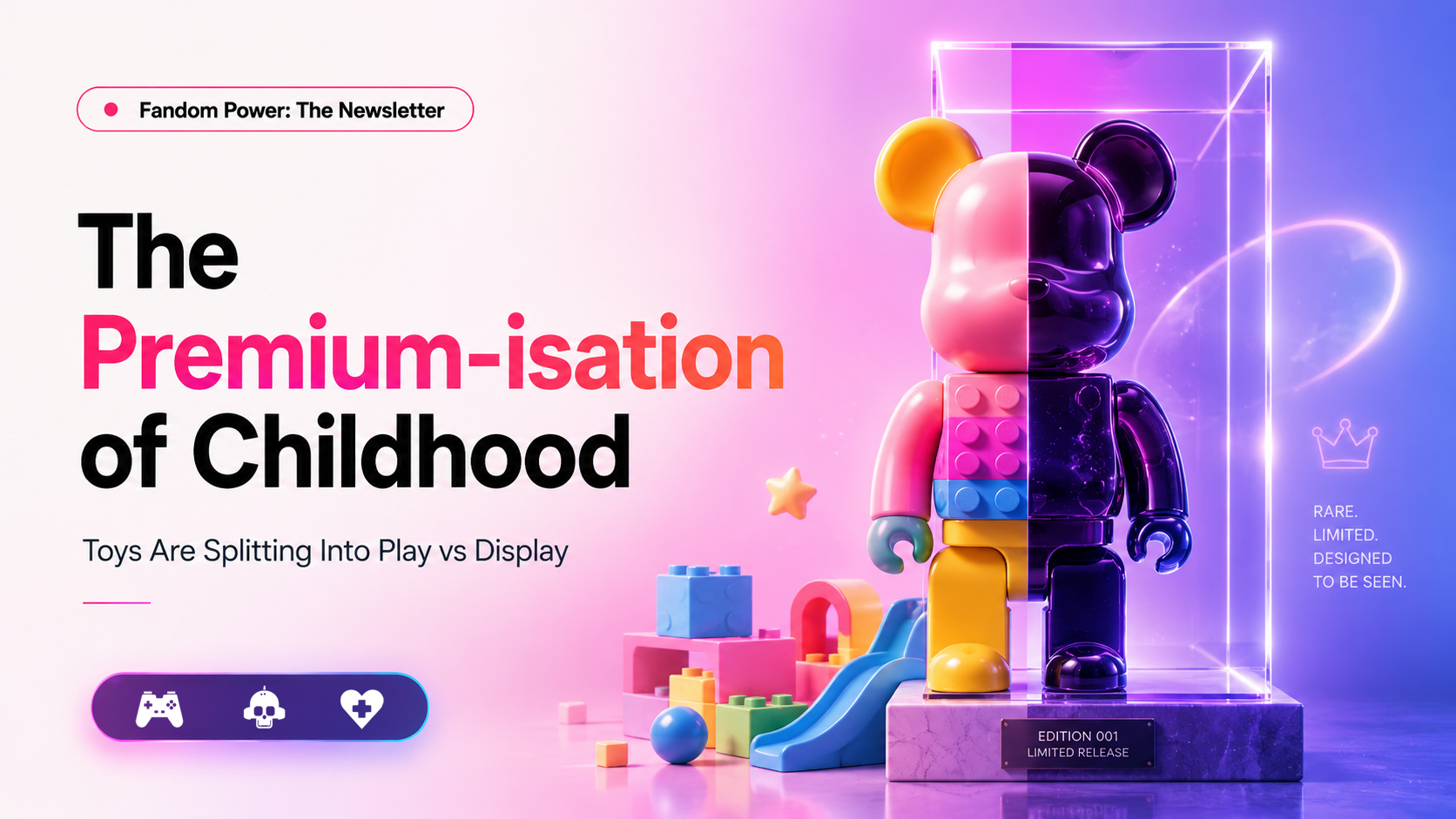
Toys Are Splitting Into Play vs Display
Walk into toy culture right now and you can feel the split.
On one side: toys as play. Shared, noisy, messy, social. Built to be handled, dropped, argued over, rebuilt.
On the other: toys as display. High-priced, limited, adult-coded, carefully staged. Less “what can I do with this?” and more “what does owning this say about me?”
A perfect recent signal is LEGO’s newly announced Pokémon line. WIRED’s take is blunt: the launch is aimed squarely at adult collectors, with price and positioning that makes it feel like “kids aren’t invited.” LEGO’s own announcement backs up the core point: the first three sets are all rated 18+, priced from roughly $60 to $650, and framed as display-first builds.
That’s a clear cultural tell.
Adult play isn’t the problem. It’s the business model.
Let’s be clear: adults playing is healthy. I have talked at length about my love for collecting, and the kidult trend, and the increasing acceptance of adults leaning into the toy space. I am one of these people… But it does give us some interesting things to look at, from a cultural perspective.
Adult fans have kept entire categories alive, from building sets to collectibles. And the toy industry has increasingly relied on them.
Circana reported that in the US, adults (18+) contributed over $1.5B in toy sales in Q1 2024, and 43% of adults bought a toy for themselves in the prior year (for enjoyment, socialisation, and collecting). Globally, Circana’s 2024 tracking across 12 markets showed building sets up 14% and licensed toy sales up 8%, with licensed toys making up 34% of the total market. Pokémon remained the top-selling toy property globally.
So yes, adult demand is real, durable, and culturally meaningful.
The shift worth interrogating is how that demand is being monetised, and what it does to the idea of toys as something for everyone.
Two lanes are forming…
You can see toys splitting into two different roles:
Co-play toys are designed for participation. They expect friction: building together, improvising, arguing over the rules, making things “wrong,” laughing, trying again. The value is social and experiential.
Display toys are designed for ownership. They reward completion and preservation. The value is symbolic: taste, status, nostalgia, collectability, often with scarcity mechanics layered in.
LEGO Pokémon’s launch is firmly in the second lane. The pricing, the 18+ rating, the first-gen nostalgia focus, and the inclusion of exclusives tied to loyalty points and premium pre-orders all reinforce the logic of “collect, display, protect.”
This is where “premium-isation” starts to matter. Not because premium products are bad, but because the centre of gravity shifts. When the highest cultural heat is attached to display objects, play becomes secondary, and children become spectators to an adult collector economy.
Those of us who work in the space know, the high value adult collectibles and toys have a far higher PR value than toys aimed soley at kids. Which is exactly why many, like LEGO, chose to launch the high PR value product, and then follow up with more kid-friendly variation down the line.
Initial impact, then mass, sustained engagement.
What gets lost when play becomes a luxury aesthetic
When toys drift toward display-first status objects, a few cultural losses follow.
First, you lose access. A $650 centrepiece build is a different proposition to a “toy” in any normal sense, especially when the average giftable toy price sits far lower. (In the UK, the average price last December was reported at around £13 in mainstream toy sales.) The gap changes who gets to participate, and how early they learn that fandom is something you buy into, not something you play into.
Second, you lose mess. Mess is how play teaches agency. It’s how kids learn to negotiate, collaborate, and improvise. Display culture is about preservation, not experimentation. It subtly trains people to value the object more than the experience.
Third, you lose intergenerational play as a norm. WIRED quotes toy culture researcher Katriina Heljakka warning that licensed collectibles can drift toward solitary, display-oriented behaviour rather than shared play, a direction that runs counter to LEGO’s long-standing multigenerational ethos. When the default product is “look, don’t touch,” it’s harder for play to be the thing families do together.
And finally, you lose the point of toys as culture-making tools. Toys aren’t just products; they’re rehearsal spaces for imagination. When toys become status furniture, imagination is replaced by acquisition.
The real opportunity: premium and playable
The answer isn’t to shame adults out of collecting. Adult fandom is part of what makes these worlds multigenerational in the first place. The kidult, or adult collector, however you want to refer to them…. they are vital.
The strategic question is: can brands hold both lanes without letting “display” swallow “play”?
The best versions of this future look like “premium with a low floor”: entry points that are genuinely accessible, products that invite co-play, and ecosystems that treat play as a behaviour worth protecting, not just a market segment. LEGO itself hints that Pokémon will expand beyond this initial collector framing, and its broader push into collaborative build modes shows they understand the social value of co-play.
Because culturally, the strongest fandoms aren’t built on display shelves.
They’re built on worn edges, shared rituals, and the kind of messy participation that makes a world feel like it belongs to you, not like you’re renting it.
That’s what gets lost when play becomes ONLY a luxury aesthetic.
And it’s what brands should fight to keep.
You can follow more of my writing on Fandoms & Pop Culture:
Linkedin (Free Newsletter): Fandom Power
Substack Premium Newsletter: Fandom Power: Signals
Lets Talk!
If this resonates, I help brands act on exactly this kind of thinking — let’s talk