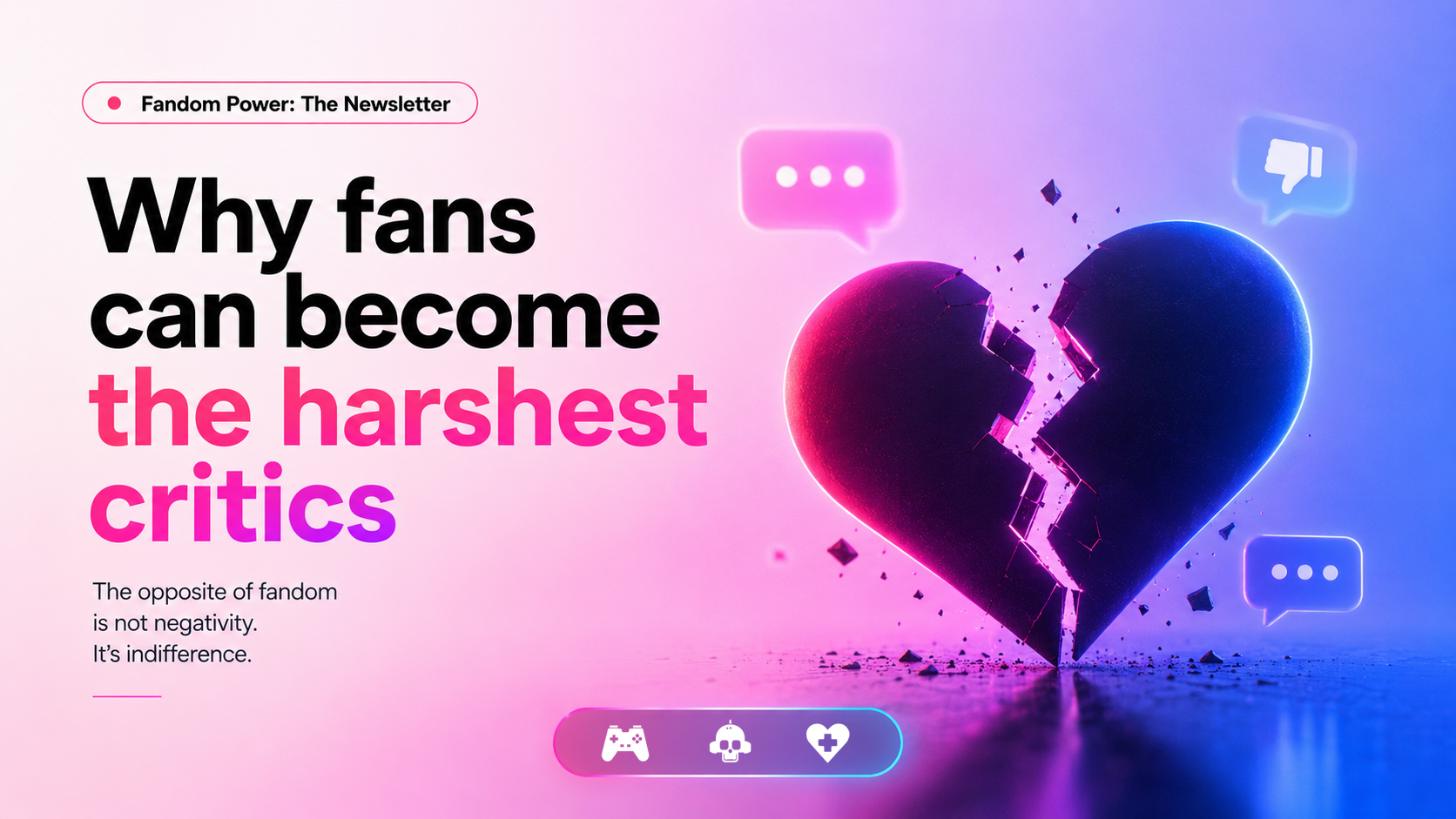
The opposite of fandom is not negativity. It’s indifference.
Most of the loudest criticism doesn’t come from people who do not care. It comes from people who care so much that the thing they love starts to feel like part of their identity. And once that happens, disappointment is rarely as simple as “I didn’t enjoy this.” It is experienced as something much closer to betrayal, exclusion, embarrassment, or even loss.
That is one reason negative fandom can feel so intense: the emotional investment is real, even when the response turns hostile.
Fans are often framed as as either loyal supporters or toxic complainers, when the reality is messier. Negative fandom is often produced by the same forces that make fandom commercially powerful in the first place: identity, belonging, interpretation, emotional labor, and community reinforcement.
That doesn’t excuse harassment or abuse. But it does explain why the line between passion and backlash can be thinner than brands, creators, and platforms want to admit.
Negative fandom is usually a relationship problem, not just a taste problem
The most useful way to think about negative fandom is not as “people being mean online.” It is as a relationship under strain.
Kresnicka Research’s Fandom Now work makes this point well: negative sentiment in fandom can be directed at the object of fandom itself, other fans, rival fandoms, or the intermediaries around the relationship such as media companies, record labels, creative teams, ticket retailers, and sports leagues. It also notes that negative emotions are natural in fan relationships and can sometimes even strengthen norms and connection inside communities. The real issue is where the line sits between constructive negativity and corrosive behavior.
That is a useful distinction.

Not all negative fandom is the same. Sometimes it is disappointment with the text. Sometimes it is anger at fellow fans. Sometimes it is resentment toward gatekeepers. Sometimes it is a fight over what the fandom “really” is. And sometimes it is grief disguised as outrage because the version of the thing a fan loved no longer feels reachable.
In other words, negativity is not always a signal of disengagement. Sometimes it is a signal that attachment has become unstable.
Why the thing you love can trigger the strongest backlash
There are a few recurring reasons this happens.
The first is identity fusion. When fans become deeply attached to an artist, franchise, team, or creator, that attachment often becomes part of how they see themselves. A 2025 study in Acta Psychologica on fans dealing with an idol’s public disgrace found that fans often go through confusion, denial, reevaluation, and self-reconstruction when the object of fandom is compromised. Importantly, the study says fans do not always simply disconnect from the fan community; many rework their identity in relation to it.
That is a powerful reminder that fandom is not just about liking something. It is often a part of who people are, how they see themselves and how they live their lives.
The second is entitlement. Not in the lazy sense of “fans are spoiled,” but in the more structural sense that participatory culture can give fans a strong belief that they have a stake in how the thing should evolve. Mel Stanfill’s Fandom Is Ugly captures the darker edge of this dynamic, arguing that ugly fandom emerges when intense attachments collide with social structures and situations that fans feel have wronged them. In those moments, the distinction between “us” and “them” hardens quickly: true fans versus fake fans, fans versus industry, fans versus critics, fans versus creators.

The third is networked amplification. Community can soften disappointment, but it can also accelerate it. Shared frustration becomes a bonding mechanism. A personal annoyance becomes a communal grievance. An interpretation becomes a purity test. Kresnicka’s work notes that fan communities can direct, amplify, or quell negative sentiment. That is crucial, because it means toxicity is not just an individual behavioral issue. It is also a community dynamics issue.
Negative fandom is not new. But the environment around it has changed
Fans have always argued. Rivalries, splits, backlash, and disillusionment are not anything. new, they are just more amplified across digitsal platforms.
What has changed is the speed, visibility, and persistence of negative fan reaction.
Ofcom’s 2025 and 2026 UK research shows that users remain highly aware of online negativity and backlash dynamics. Its Children’s Media Lives report found apprehension about public posting due to fears of negativity and social backlash, which pushed some users toward private or more carefully curated participation. Its April 2026 media habits release also found people talking about passive and sometimes draining online experiences more broadly.
That wider context matters because fandom negativity does not happen in isolation; it happens inside platforms optimized for response, identity display, and social reinforcement.
That changes the shape of negative fandom in at least three ways.
First, it becomes more performative. Second, it becomes more contagious. Third, it becomes harder for brands and creators to distinguish between criticism, pile-on, and organized hostility.
This is one reason why backlash can feel disproportionately large even when it is being driven by a relatively concentrated group. Digital fandom spaces highlight intensity, not nessisarily in relation to scale.
The commercial problem most brands miss
Brands and rights holders often underestimate negative fandom because they still read fandom primarily through an engagement lens.
But negative fandom can have real business consequences.
It can distort launch narratives. It can damage creator relationships. It can fracture communities. It can make casual or adjacent audiences less likely to enter. And it can shift energy away from growth and toward internal conflict.

At the same time, overreacting to negativity can be just as damaging.
The trap is assuming all criticism is toxicity…. It is not.
Some negative fandom is a sign that the brand, franchise, or creator has failed to understand the emotional contract it has with its community. Some of it is fans articulating a gap between what was promised and what was delivered. Some of it is a warning that trust is eroding. The business challenge is not to eliminate negative feeling. It is to tell the difference between healthy friction and destructive escalation.
That distinction matters because healthy negativity can actually be useful. It can clarify norms, reveal unmet expectations, and surface what parts of the experience people care about most. But once the community dynamic tips into harassment, identity policing, or status competition through outrage, the costs rise fast.
My take: negative fandom is the shadow side of belonging
The more I look at this space, the more I think negative fandom is best understood as the shadow side of belonging.
Fandom is powerful because it gives people connection, meaning, identity, routine, language, and shared emotional experience. But those same conditions can also create possessiveness, fragility, tribalism, and backlash when the object of fandom changes, disappoints, or becomes socially complicated.

That is why “just ignore the haters” is not a serious strategy.
It misses the point.
A lot of negative fandom is not random hostility from outside. It is unresolved tension from inside.
And if that is true, then the job for marketers, community teams, and rights holders is not simply moderation after the fact. It is relationship design before the flashpoint.
What marketers should actually do
This is where negative fandom becomes a practical issue, not just a cultural one.
Three things matter most.
1. Track the type of negativity, not just the volume. Do not lump everything into one sentiment bucket. Separate disappointment with the product, anger at the brand, intra-community conflict, creator backlash, and harassment. They behave differently and need different responses. Kresnicka’s framework is useful here because it explicitly distinguishes between targets of negative sentiment.
2. Watch for identity rupture moments. These are the moments when fans feel the thing no longer reflects who they thought they were in relation to it: scandals, major creative pivots, pricing shocks, perceived betrayals, exclusionary decisions, canon disruptions, or sudden value shifts. The Acta Psychologica study is a strong reminder that these moments are processed psychologically, not just rationally.
3. Treat community norms as infrastructure. The best protection against ugly fandom is not just reactive moderation. It is healthier community architecture: clearer rules, better expectation-setting, visible trusted voices, lower ambiguity in official communication, and spaces where disagreement does not automatically become status warfare. Stanfill’s work on networked harassment and Kresnicka’s work on amplification both point to the importance of the social environment, not just the individual bad actor.
The real lesson
If positive fandom tells you what people love, negative fandom often tells you what they believed they were owed.
That makes it uncomfortable, but also revealing.
Because underneath the backlash, there is usually a more interesting question:
What promise did the fandom think had been made? And what happened when that promise no longer felt true?
That is where the real strategic insight lives.
Sources
This piece was shaped in part by the BBC Bitesize article Why can fans be so negative about the thing they love?
Key supporting sources: Mel Stanfill, Fandom Is Ugly: Networked Harassment in Participatory Culture (2024/2025 online edition)
Wenbo Huang et al., Fans’ self-identity crisis and reconstruction in the context of idol disgraced (2025)
Kresnicka Research, Fandom Now: anti-fandom, toxicity, and negative sentiment in fandom (2023)
Ofcom’s Children’s Media Lives 2025 and April 2026 adult media habits release
You can follow more of my writing on Fandoms & Pop Culture:
Linkedin (Free Newsletter): Fandom Power
Substack Premium Newsletter: Fandom Power: Signals
Lets Talk!
If this resonates, I help brands act on exactly this kind of thinking — let’s talk