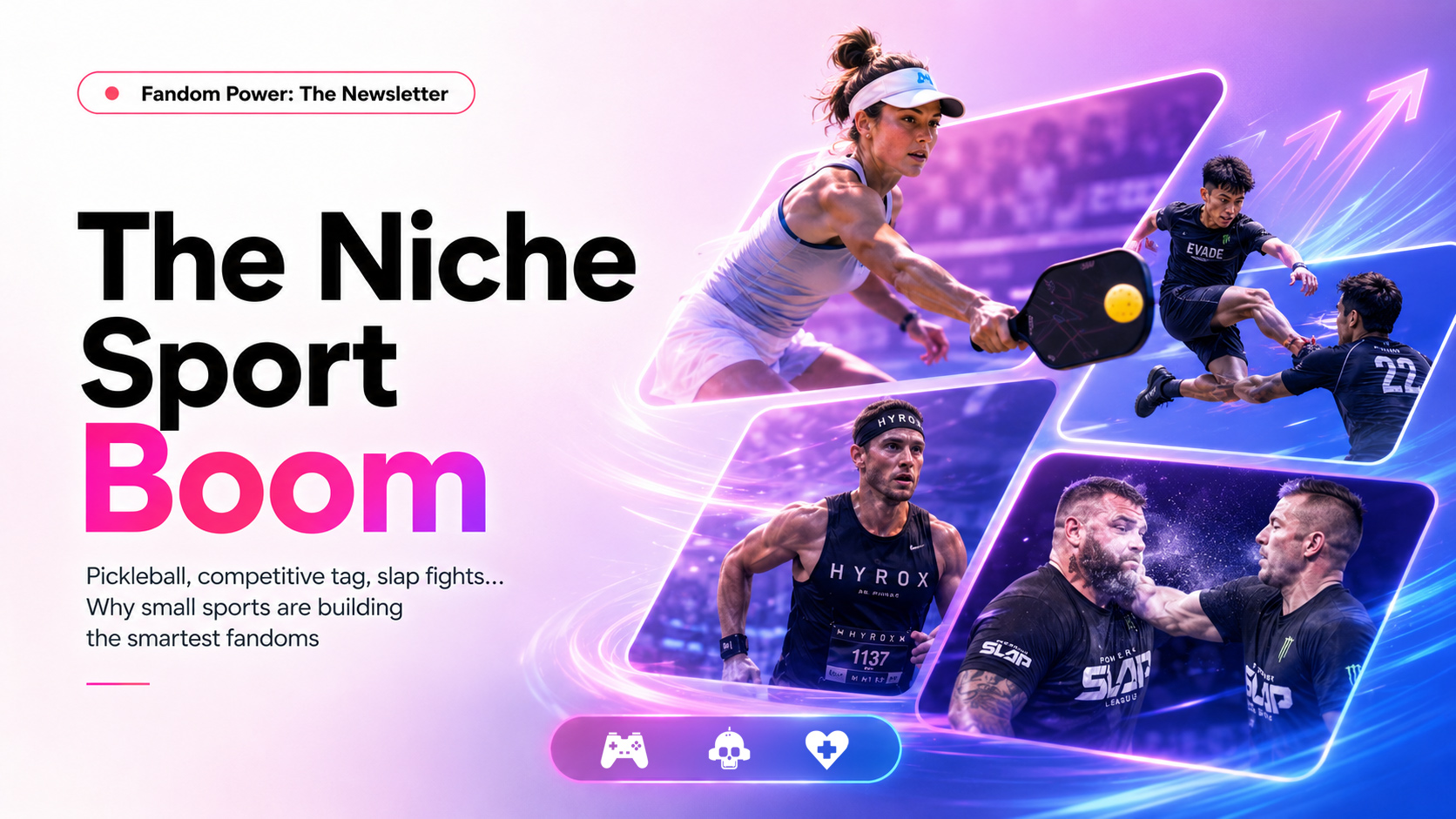
Pickleball, competitive tag, slap fights… Why small sports are building the smartest fandoms
Something’s happening in sport that a traditional big league mindset doesn’t fully explain.
A bunch of supposedly niche sports are growing like cultural products: Pickleball, World Chase Tag, Hyrox, padel, SailGP… even Power Slap (controversial, but undeniably engineered for attention). To put it simply, they’re winning because they understand modern fandom mechanics.
And those mechanics are increasingly simple: easy to join, easy to share, easy to belong.
Pickleball’s growth is a participation engine, not a broadcast story
Pickleball has exploded because the entry cost is low. You can try it fast, you can play it socially, and you can get “good enough” without a decade of fluency. It’s easy to pick up, easy to understand, accessible and fun.
The result is scale that’s hard to ignore: SFIA reports 19.8M Americans played pickleball in 2024 (up 45.8% vs 2023). SFIA also noted the 25–34 age group as the biggest participation cohort in 2023 (2.3M players).
And once participation becomes the funnel, media follows. The National Pickleball League landed a TV deal with CBS Sports heading into 2024.
That’s the pattern to watch: playability first, fandom second, media third.

World Chase Tag is basically built for Shorts
World Chase Tag isn’t trying to win on tradition. It’s trying to win on legibility.
The rules are instantly understandable. The arena is visually distinctive. The “story” fits inside a clip. Sports Video Group reports WCT expanding to 46 Quads in 15 countries, and notes that each individual chase averages 2M views on WCT social channels.
None of this is by accident. From the off, it’s a sport designed around the fact that discovery now happens through someone sending you a 12-second moment.

Power Slap shows the extreme end of the same logic
Slap fighting sits in a morally complicated place, and it’s not the kind of fandom growth story every brand should want to emulate. But it’s still a useful signal: the format is built to be clipped, like all combat sports it’s argued about, and most importantly, it’s shared at scale.
Power Slap moved from Rumble to YouTube, with reporting describing a deal powered by a sponsorship with VeChain (reportedly $76M over six years) and an emphasis on platform reach and control.
Whether you see it as sport or spectacle, it’s designed around one truth: attention now travels through moments you can’t look away from.

Not every niche sport grows through shock. Some grow through identity.
Hyrox is a perfect example of sport behaving like a social ritual. The Guardian reported global participation rising from 175,000 (2023–24) to 650,000 (2024–25), with organisers targeting one million participants by 2026.
Padel is doing something similar on a global scale. Playtomic and Strategy& project 70,000 padel courts worldwide by 2026. And the Financial Times has covered how events like the Hexagon Cup are explicitly trying to convert players into fans by building teams, identities and a wider ecosystem, not just staging matches.
These aren’t just sports products. They’re products that allow fans to build belonging.

So what’s the real pattern?
Across all of these, the winners share a few traits:
They lower the barrier to entry.
They make the experience socially portable (clips, stories, proof-of-presence).
They give fans an easy way to participate (not just watch).
That’s why niche sports can grow faster than legacy sports: they’re not asking for inherited loyalty. They’re offering instant belonging.
What this means (beyond sport)
If you work with brands, agencies, platforms, IP, retail, basically any business that lives or dies by attention, the real lesson here is that the fastest-growing fandoms today are built on mechanics, not messaging.
1. Make participation the front door.
The easiest communities to grow aren’t the ones you persuade with ads, they’re the ones people can try, join, or do with minimal friction. A low-stakes entry point turns curiosity into self-identification quickly.
2. Design for shareable understanding, not just shareable moments.
Clip culture isn’t just about highlights; it’s about onboarding. The winners are easy to explain, easy to repeat, and easy for creators to translate into community language. When interpreters can carry your story, distribution becomes organic.
3. Build rituals that create return behaviour.
One-off events create spikes. Rituals create habit. Habit creates identity. Whether it’s weekly formats, seasonal beats, drops, challenges, recaps, or community moments, repeatability is what turns interest into a relationship.
4. Because the real competition now isn’t for impressions.
It’s for repeat presence, the place you occupy in someone’s routines, identity, and social world.
You can follow more of my writing on Fandoms & Pop Culture:
Linkedin (Free Newsletter): Fandom Power
Substack Premium Newsletter: Fandom Power: Signals
Lets Talk!
If this resonates, I help brands act on exactly this kind of thinking — let’s talk